Social Sustainable Procurement

Policy and Basic Mindset

Purchasing (Supply Chain Management)

The UBE Group strives to establish mutually beneficial, fair and equitable trade relations with our business partners. The UBE Group Basic Policy for Sustainable Procurement outlines the Group’s compliance activities in the areas of fair and equitable transactions, objective assessment in the selection of business partners, legal compliance and confidentiality, green procurement, and sustainable procurement. To encourage our business partners to proceed with sustainability initiatives, we also promote sustainable procurement throughout the entire supply chain.

UBE Group Basic Policy for Sustainable Procurement

Based on its purpose and management philosophy, the UBE Group will focus on legal compliance, fair and equitable transactions, and objective evaluation in the selection of business partners. We will realize sustainable procurement throughout the supply chain by engaging our business partners in sustainability initiatives.

Scope

This policy applies to the UBE Group (UBE Corporation and its consolidated subsidiaries) as well as group companies and their tier 1 suppliers outside the consolidation, where UBE Corporation is deeply involved in the purchase of raw materials and equipment. In cases where suppliers procure raw materials from regions with risks of conflict minerals or human rights violations, secondary suppliers will also be covered.

Goal

In our procurement activities throughout the supply chain, we will realize social values such as health, safety, freedom, equality, ethics, fairness, and equity for people affected in the value chain, including employees and local communities. To achieve this, we will implement the following measures:

  1. Fair and Equitable Transactions
    We conduct transactions based on fair, equitable, and free competition that do not involve personal interests or arbitrariness, and always strive to create business opportunities with new suppliers. In addition, we build an equal and fair cooperative relationship with our suppliers and strive to improve mutual understanding and trust from a long-term perspective.
  2. Objective Evaluation in Supplier Selection
    We comprehensively consider quality, price, delivery time, etc. when selecting suppliers, and make decisions based on economic rationality.
  3. Compliance with Laws and Regulations and Confidentiality
    We comply with all relevant laws, regulations, and social norms in our purchasing activities, and maintain the confidentiality obtained in the course of transactions.
  4. Green Procurement
    We conduct green procurement activities in the selection of purchased products, taking environmental protection into consideration.
  5. Sustainable Procurement
    We promote sustainable procurement throughout the supply chain in order to enhance social credibility. We strive to prioritize procurement from suppliers who meet the following requirements.
    • Establish an internal system to promote sustainability
    • Emphasis on ensuring stable supply and quality
    • Comply with corporate ethics, laws, regulations, and social norms, and engage in fair transactions.
    • Emphasis on environmental friendliness
    • Respect for human rights and safety and health management
    • Emphasis on social contribution and communication with society, and information management and disclosure

Commitment

  • We request our suppliers to comply with the UBE Group Sustainable Procurement Guidelines and monitor the status of their sustainability initiatives.
  • We identify high risks such as human rights, the environment, and minerals in the supply chain, and conduct procurement with consideration for risk countermeasures and sustainability.
  • By 2030, we will achieve the following targets.
    • 100% procurement from suppliers that meet our minimum certification (supplier registration) requirements
    • 100% procurement from suppliers who have endorsed the UBE Group Sustainable Procurement Guidelines
    • 100% procurement from suppliers that have been confirmed to have no human rights risks
    • 100% procurement from suppliers that have been confirmed to be free of conflict minerals risk
    • SAQ implementation rate (ratio of procurement amount) based on sustainability surveys: 95% or more

Responsible Departments and Review

The Purchasing & Logistics Department is responsible for overseeing and managing this policy.

This Policy is subject to regular review at least once every two years. Any revisions, whether part of a scheduled review or required during the fiscal year, will be deliberated and approved by the Supply Chain Management Committee.

UBE Group Sustainable Procurement Guidelines

The UBE Group engages in a variety of sustainability initiatives in order to earn the confidence of diverse stakeholders, including shareholders, customers, business partners, employees, and communities. To enhance the social credibility of the Group, we practice sustainable procurement throughout the entire supply chain, which includes all of our business partners.

The UBE Group Sustainable Procurement Guidelines are as follows.

1. Internal structure for practicing sustainability

  1. Maintain corporate philosophy, basic management policy, and action guidelines, etc., for practicing sustainability within the organization.
  2. Establish an organizational framework for practicing sustainability within the organization.
  3. Produce and publish a report related to sustainability and the environment.

2. Ensuring stable supply and quality

  1. To prepare for such contingencies as disasters and accidents, establish and maintain a risk management framework on a regular basis and inform all employees about it.
  2. Establish a business continuity plan (BCP) that stipulates in advance the plan for securing business continuity in an emergency situation due to a disaster like an earthquake or influenza outbreak, and inform all employees about it.
  3. Conduct assessments and tests to ensure product safety, and enable traceability. Also, put in place a certified quality management system such as ISO 9000.

3. Corporate ethics, compliance with the law and social norms, and fair transactions

  1. Comply with the various laws, regulations, government directives, and rules applicable to business operations (Japan’s Companies Act, Antitrust Act, and Subcontractors Act, and similar laws in other countries, labor-related laws and regulations, environment-related laws and regulations, etc.).
  2. Develop an internal whistleblowing system for reporting illegal activities.
  3. Prohibit the offering and acceptance of inappropriate benefits.
  4. Prohibit transactions with organized crime and other antisocial forces (individuals or groups).
  5. Practice fair transactions with business partners.

4. Consideration for the environment

  1. Obtain external certifications for environmental management systems (systems for the overall management of environmental initiatives* encompassing an organizational framework, systematic initiatives, and assignment of responsibilities), such as ISO 14001 certification. Establish, operate, and continuously improve environmental management systems.
    *Environmental initiatives include establishing environmental policies, implementing measures according to those policies, and executing plan-do-check-action (PDCA) cycles for environmental conservation initiatives.
  2. Suitably manage and dispose of industrial waste according to the laws and regulations of the country in which the business operates. Practice the three Rs (reduce, reuse, and recycle) in all business activities. Additionally, establish voluntary targets for reducing landfill waste, such as by practicing resource recycling, and continually reduce landfill waste.
  3. Establish voluntary targets for resource conservation and energy reduction, and continually ensure that resources and energy are effectively used.
  4. Establish voluntary targets for reducing greenhouse gas (GHG) emissions, including carbon dioxide, methane, and nitrous oxide, and continuously reduce GHG emissions.
  5. Continuously reduce water consumption through the optimal and effective use of water resources. Additionally, strive for water circulation that suitably preserves the function of water in human activities and for conservation of the environment.
  6. Strive to exist in harmony with nature through consideration for biodiversity.
  7. Secure compliance with laws and regulations relating to environmental conservation such as those concerning air emissions, water quality, and chemical substance emissions in the country in which the business operates and, if necessary, set voluntary standards to further raise compliance.

5. Respect for human rights, safety, and health

  1. Prohibit all behavior that is inhumane. Prohibit all behavior that is inhumane including any form of abuse, corporal punishment or harassment. Practice respect for human rights.
  2. Prohibit child labor. Prohibit the employment of children who are below the minimum working age and ensure that legally employed young people are not assigned work that would hinder their development.
  3. Prohibit forced labor. Ensure that all employees are employed of their own free will and are never subjected to forced labor.
  4. Prohibit overwork. Suitably manage employees’ working hours, holidays, and vacations to ensure that they do not work more hours than legally permitted.
  5. Pay suitable wages. Ensure that employees are paid at least the legally mandated minimum wage and prohibit the unjust reduction of wages.
  6. Prohibit all forms of discrimination. Eliminate any discrimination in the recruitment and employment of human resources, and treat human resources fairly such as by providing equal opportunities.
  7. Respect the fundamental rights of workers. Respect fundamental labor rights, including freedom of association and the right to collective bargaining, and build good relations with employees through close dialogue.
  8. Suitably manage occupational safety. Ensure a safe work environment by identifying and managing the risk of accidents and human exposure to harmful chemical substances, noise, odors, etc., in the workplace.
  9. Suitably manage the physical and mental wellbeing of employees. Secure compliance with relevant laws and regulations in the country in which the business operates and obtain health management certifications as recommended at the national and state/provincial levels.

6. Social contribution, communication with society, and information management and disclosure

  1. Actively engage in social contribution activities.
  2. Accurately report information needed by shareholders, such as financial information, outside the company.
  3. Disclose in a timely and appropriate manner information related to quality and product safety.
  4. Develop internal rules regarding the prevention of leaks of confidential information, and implement relevant system measures. Also, establish regulations regarding the protection of confidential information obtained through business transactions as well as personal and customer information, and manage it appropriately.
  5. Implement measures to protect against such threats to computers and networks as computer viruses.

UBE Group Sustainable Procurement Management Standards

In order to enhance our corporate value and realize maximum satisfaction among our employees and partners, we at the UBE Group have established procurement management standards. These standards take the contents of the UBE Group Basic Policy for Sustainable Procurement and the UBE Group Sustainable Procurement Guidelines into account and encapsulate the shared values toward procurement among the UBE Group. There are various rules, practices, and measures related to procurement at each UBE Group company, but these standards are applicable to UBE Group corporations around the world and were made with a universal mindset toward procurement management in the UBE Group.

Commitment

  1. In the course of procurement activities, the Company will strive to respect domestic and international laws, regulations, and social norms while asking the same of its partners
  2. Selections of and negotiations with suppliers that become partners will be undertaken fairly and equitably
  3. Information gained when selecting partners or in the course of business transactions will be appropriately managed in accordance with such rules as the UBE Group Basic Policy for Information Management
  4. Intellectual property will be considered an important management resource and rights held by the UBE Group will be protected while respecting the intellectual property of partners
  5. Staff involved in procurement will be provided with opportunities to receive appropriate education
  6. Staff involved in procurement will respect the UBE Group Code of Conduct and the UBE Group Procurement Staff Code of Conduct while conducting fair, equitable, and honest procurement activities

Conducting Procurement Due Diligence

  • When registering new partners, verification will be conducted of procured goods and partner management systems with appropriate decisions made based on the rules and regulations of each UBE Group company
  • Based on the methods established by each UBE Group company, regular inspections will be conducted to ensure the absence of human rights violations at partner companies and in the procurement of conflict minerals as well as to ensure the progress of sustainability measures

Improvement/Remedy Measures

  • The results of regular inspections of business partners will be reviewed with said partners while overall results are published on such locations as homepages, thus providing partners with opportunities to gain fresh insights on their initiatives
  • For partners determined to be still in the process of enacting sustainability initiatives, Company departments in charge of sustainability will provide a forum that provides opportunities to exchange and discuss individual opinions and enact improvements

UBE Group Procurement Staff Code of Conduct

To ensure the actions of staff charged with undertaking procurement are in line with corporate ethics or social norms, we promote fair and equitable procurement under the following Code of Conduct.

  1. ①Staff involved in procurement activities will respect all laws and regulations related to procurement. If any employee learns of a case in violation of such laws and regulations, they will swiftly report it to their superiors and it will be handled appropriately.
  2. ②Staff involved in procurement activities will not accept such gifts from business partners as mid-year or year-end gifts. They will also refuse such courtesies as congratulatory or condolence payments.
  3. ③Staff involved in procurement activities will not acquire unlisted shares from business partners and will not acquire stocks after obtaining insider information.
  4. ④Staff involved in procurement activities will not accept special discounts or services on partner products for the purpose of personal use.
  5. ⑤Staff involved in procurement activities will not make requests for benefits or favors for themselves from business partners and will not maintain any position that constitutes a conflict of interest.
  6. ⑥Staff involved in procurement activities will not accept improper entertainment from business partners. They will also not provide business partners with such entertainment.
  • *Staff involved in procurement activities include all staff related to procurement, materials, purchasing, quality management, production technology, other development, or transactions with business partners.

Policy on Conflict Minerals

The UBE Group practices the responsible procurement of raw materials in order to meet its social responsibilities as a corporation. We strive to trace the origins of six types of minerals, consisting of four identified as being of special concern (tin, tantalum, tungsten and gold) as well as cobalt and mica, which have recently been subject to rising social demand for traceability. We thus determine the presence of such minerals in purchased raw materials and verify details regarding procurement sources when the incorporation of any of these raw minerals is considered unavoidable in light of their characteristics.

If inspections show that conflict minerals (minerals that are mined and sold under the control of armed groups in the Democratic Republic of the Congo and surrounding regions) are used in purchased raw materials, the Group will immediately stop procurement of said raw materials or pressure business partners to change their procurement sources.

Support for Declaration on Partnership Building

April 1, 2022 — UBE Corporation announces its endorsement of the intent of the Declaration on Partnership Building [Japanese]established by the Council on Promoting Partnership Building for Cultivating the Future, whose members include the Chairman of Keidanren, the Chairman of the Japan Chamber of Commerce and Industry, the President of the Japanese Trade Union Confederation (RENGO), and relevant ministers (Minister of State for Economic and Fiscal Policy, Minister of Economy, Trade and Industry, Minister of Health, Labour and Welfare, Minister of Agriculture, Forestry and Fisheries, and Minister of Land, Infrastructure, Transport and Tourism). In accordance with this endorsement, the Company has issued its Declaration on Partnership Building.

Based on its founding spirit of coexistence and mutual prosperity, UBE will continue to enhance collaboration with suppliers with the goal of adding value throughout the supply chain.

In April 2025, UBE updated this declaration in response to the revision of the Promotion Standards (based on the Act on the Promotion of Subcontracting Small and Medium-sized Enterprises, hereinafter “the Act”), which consists of additional important initiatives, including desired practices for transactions between new business operators and subcontractors (compliant with the Promotion Standards based on the Act). In September 2025, UBE announced the addition of initiatives related to health management, such as providing expertise on health management to our suppliers.

Declaration on Partnership Building

1. Coexistence and mutual prosperity throughout the supply chain, and new collaborations across all corporate sizes and affiliations

  • We will strive to work together with our business partners to realize a sustainable society that is conscious of human rights, labor standards, the environment and our other social responsibilities.
  • Health management initiatives (providing knowledge in the course of health management, mutual conduct of health improvement measures, etc.)

2. Compliance with the “Promotion Standards”

  1. (1) Pricing method
    • We will not demand unreasonable price reductions. With regard to setting transaction prices, at least once a year we engage subcontractors in discussions to ensure such subcontractors are paid fairly and that they strive to maintain appropriate working conditions and benefits. Before making a decision, we always ensure that appropriate action has been taken in accordance with “Guidelines on Price Negotiation for Appropriate Pass-through of Labor Costs.” In addition, should a sudden increase in raw material or energy costs occur, we will strive to pass on the entire amount in the form of appropriate cost increases.
  2. (2) Cost burdens such as mold management
    • We conduct mold transactions with consideration for basic mindsets and policies on such transactions as well as memorandums on handling molds, promote the disposal of unneeded molds, and will not request subcontractors to store the molds without compensation.
  3. (3) Terms of payment by bill, etc.
    • We will pay subcontracting fees in cash as much as practicable. Should we pay those fees by promissory notes, we will never have subcontractors pay discounts or other fees. We will also set terms of payment to be made within 60 days.
  4. (4) Intellectual property and knowhow
    • We will not urge subcontractors to enter into any one-sided non-disclosure agreement or take advantage of our trading position to demand that they disclose their know-how.
  5. (5) Consideration for work-style reforms, etc.
    • We will not require subcontractors, without proper compensation of the increased costs, to complete subcontract work within an unreasonably short term, nor will we direct sudden changes to the specifications of subcontract work, so that subcontractors can also pursue work-style reforms.

3. Other

  • We have published guidelines to enhance UBE’s social credibility throughout the supply chain, including among business partners.
  • In order to end the use of promissory notes, we will work to promote a shift to cash payments and electronic record receivables, including transactions between large corporations.
Management System

Supply Chain Management Committee

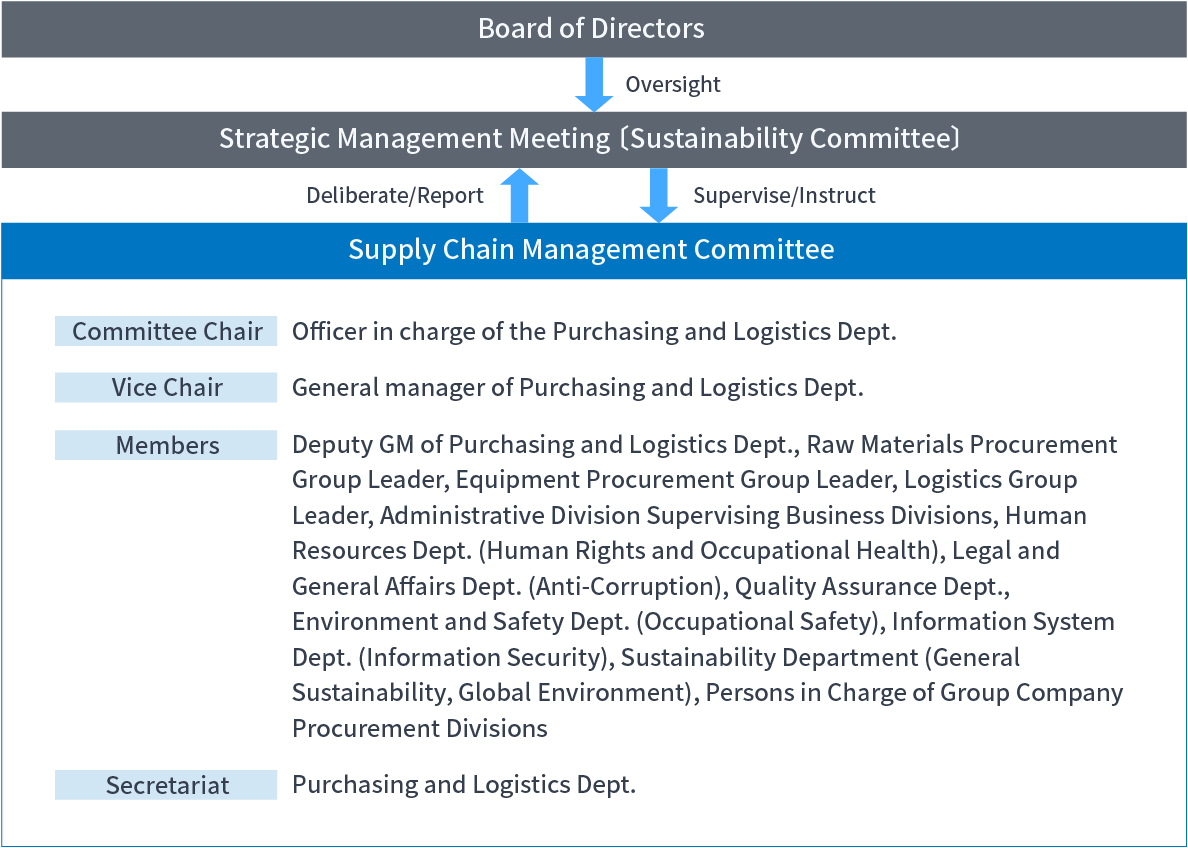
To further enhance the promotion of sustainable procurement across the supply chain, we established the Supply Chain Management Committee in April 2024, which is chaired by the officer in charge of the Purchasing and Logistics Dept. This Committee deliberates and reports on matters to our Strategic Management Meetings (Sustainability Committee), which are chaired by our President.

The Supply Chain Management Committee is an interdepartmental organization that identifies risks to the UBE Group related to sustainable procurement and deliberates and decides on response policies while setting goals to manage and promote proper sustainable procurement.

Targets and Performance

Indicator Scope FY2024 FY2025 FY2030
Scope Raw Materials Equipment Performance Targets Targets Targets
Proportion of value-based procurement purchased from suppliers that align with our minimum requirements UBE Corporation 100% 100% 100% 100%
Proportion of value-based procurement purchased from suppliers that consent to the UBE Group Sustainable Procurement Guidelines UBE Corporation 97.50% 100% 100% 100%
Proportion of value-based procurement purchased from suppliers who are able to confirm zero human rights risks in individual evaluations UBE Corporation 100% 100% 100% 100%
Proportion of value-based procurement purchased from suppliers who are able to confirm zero conflict mineral risks in individual evaluations UBE Corporation 100% 100% 100% 100%
Proportion of value-based procurement purchased from suppliers who have completed SAQ sustainability surveys UBE Corporation 91.00% 90% 90% 95%

Sustainable Procurement

The UBE Group has established the UBE Group Basic Policy for Sustainable Procurement and the UBE Group Sustainable Procurement Guidelines. These encompass respect for human rights, compliance with laws and social norms such as the exclusion of organized criminal groups and other anti-social forces, and commitment to the environment. Under the policy and guidelines, the Group aims to enhance sustainable practices throughout its supply chain. The latest edition of the guidelines, which are regularly revised to align with the latest societal demands, was published on the UBE Group website in June 2024. The Group informs new business partners of the UBE Group Basic Policy for Sustainable Procurement and the UBE Group Sustainable Procurement Guidelines and refers them to the Group’s website, and we request their cooperation with the Group so that we may promote sustainable procurement as a unified body.

Results from the Fifth Sustainability Survey of Business Partners

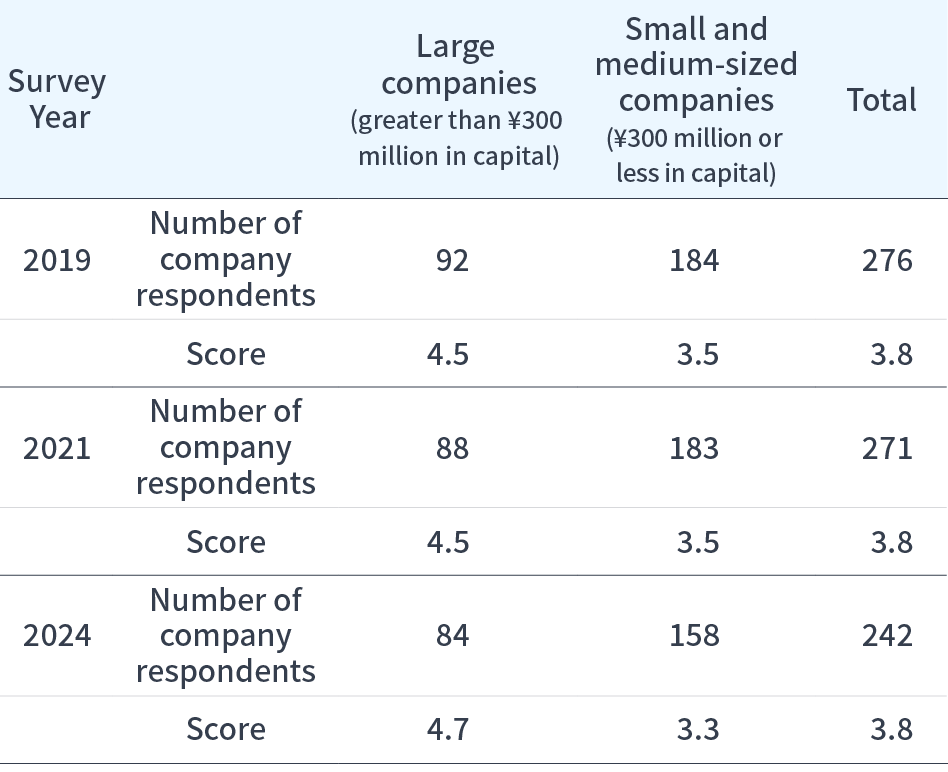
Since fiscal 2012, the Group has conducted surveys of business partners regarding sustainability, and in the fifth round in fiscal 2024, we received responses from 242 major suppliers who collectively account for 91% of the purchase value of equipment, raw materials and fuel, and packaging materials. The survey responses were aggregated and analyzed to provide feedback for all Group companies. The UBE Group also met with suppliers with lower ratings to help them improve their efforts in this regard.

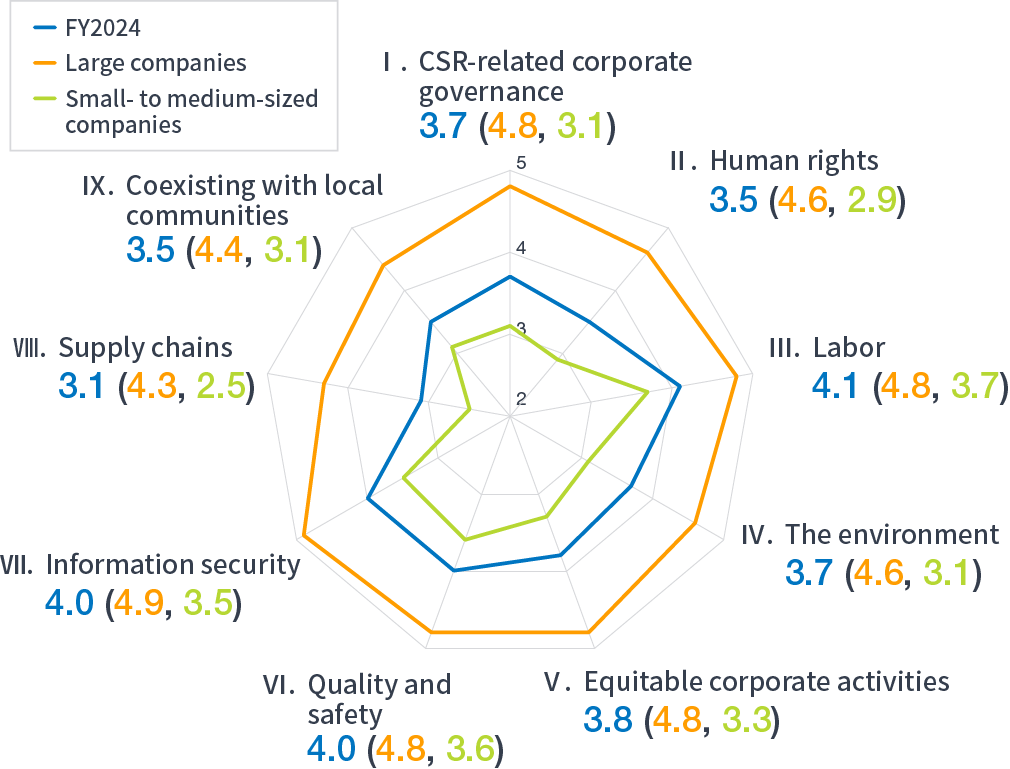
Using ratings from 1 to 5, the survey asked business partners to self-evaluate in nine thematic areas (114 questions in total): (1) CSR-related corporate governance; (2) Human rights; (3) Labor; (4) The environment; (5) Equitable corporate activities; (6) Quality and safety; (7) Information security; (8) Supply chains; and (9) Coexisting with local communities. The survey found an overall average rate of 3.8, indicating that business partners are engaging in a decent level of effort on their initiatives. Large companies showed a high level of effort, at 4.7, while small and medium-sized companies were relatively low, at 3.3—a difference of 1.4 points. Levels were effectively unchanged from the Fourth Survey.

A breakdown by topic revealed a high level of effort related to initiatives, at 4.1, in the “(3) Labor” category while the “(8) Supply chain” category was a relatively low 3.1.. Also, we understand that suppliers’ organization of policy and guideline systems for supply chains is an issue for companies of all sizes, with the “(8) Supply chain” category seeing the lowest scores across the board. In response, we provided suppliers with feedback on results and asked them to consider making improvements.

In prior years, including for the Fourth Survey, we independently determined the survey questions. For the Fifth Survey, however, we began to use the Self-Assessment Questions created by the UN Global Compact Network Japan (GCNJ). Based on the shared SAQs of the GCNJ, in which over 600 corporations and groups participate, we strove to reduce the burden suppliers took on when answering questions while seeking to conduct surveys, evaluations, and verifications in line with global standards. For more details on survey results, please visit Results of the Fifth Sustainability Survey of Business Partners.

FTSE Blossom Japan Index: Supply Chain Evaluation by FTSE Russell

The FTSE Blossom Japan Index of stocks was created by FTSE Russell. Its constituents include Japanese companies with outstanding environmental, social, and governance (ESG) initiatives. UBE has been selected as a constituent of this index. UBE’s inclusion is based on its Group-wide efforts to promote sustainable procurement, including the implementation of its Sustainable Procurement Policy and the UBE Group Sustainable Procurement Guidelines. This policy and these guidelines encompass respect for human rights, compliance with laws and social norms such as the exclusion of organized criminal groups and other anti-social forces, and commitment to the environment. In the area of supply chain efforts, the Group received a high score of four out of five from the index managers.

UBE has been selected as a constituent of this index.

Initiatives (Procurement)

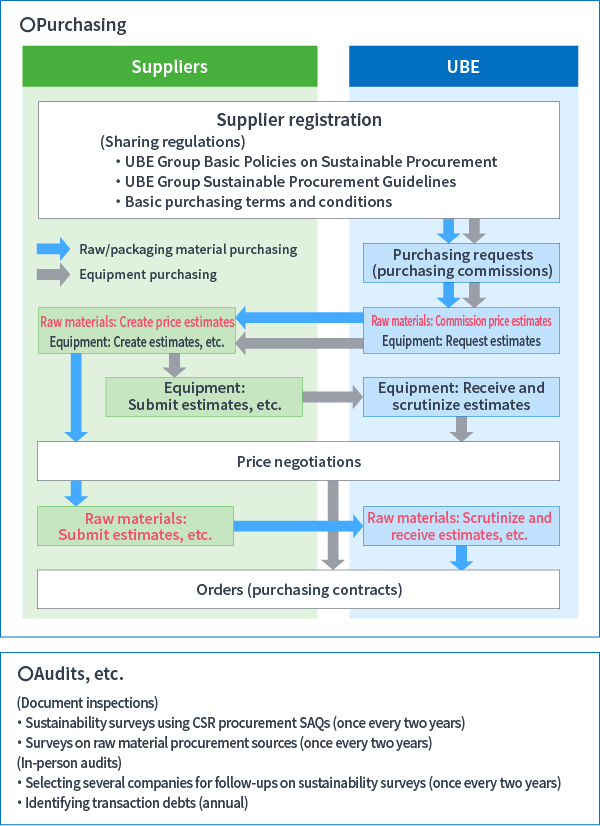
Flow of Evaluations and Support for Improvements Prior to and Following Transactions

figure

Sustainable Procurement Policy: UBE Group Sustainable Procurement Guidebook

In addition to standards for product quality, prices and delivery times, the UBE Group promotes responsible procurement activities from a social perspective, with a focus on human rights and labor, and from an environmental perspective, through the promotion of renewable energy and biodiversity conservation. Our mindset toward procurement has been codified in the UBE Group Basic Policy for Sustainable Procurement and the UBE Group Sustainable Procurement Guidelines, which we ask our business partners to respect and uphold as we work together across the entire supply chain to realize a sustainable society.

Specifically, once new business partners have gained an understanding of our policies and mindset through the UBE Group Sustainable Procurement Guidebook, they must conduct internal due diligence before commencing transactions. We begin our transactions with them only after verifying that the results of this evaluation are satisfactory. Once transactions with them commence, we regularly monitor their understanding of our guidebook.

  • UBE Group Sustainable Procurement Guidebook
    The UBE Group creates Sustainable Procurement Guidebooks that include basic mindsets and rules for activities related to procurement with the aim of realizing a sustainable society.
    This guidebook includes such regulations as the UBE Group Basic Policy for Sustainable Procurement, UBE Group Sustainable Procurement Guidelines, Policy on Conflict Minerals, UBE Group Sustainable Procurement Management Standards, and UBE Group Procurement Staff Code of Conduct. Through these, we promote responsible procurement that considers environmental and human rights issues and strive to have our many suppliers understand and cooperate with these efforts.

Basic Purchasing Terms and Conditions

We have established Basic Purchasing Terms and Conditions to govern the procurement of equipment as well as construction, fuel oil and packaging materials, and we ensure fair business operations by requiring our business partners to comply. When necessary and appropriate, we reappraise the Basic Purchasing Terms and Conditions, such as when societal demand increases or changes, and ensure the content aligns with the Group’s Basic Purchasing Policies and other similar policies.

The contents of our Basic Purchasing Terms and Conditions of our major Group companies are in alignment, and matters related to sustainability are as follows.

  • Basic Purchasing Terms and Conditions (excerpt)
  • Article 33 (Sustainable procurement)
  • Article 35 (Eliminating antisocial elements)

Please view our Basic Purchasing Terms and Conditions at the following site (Japanese).

https://www.ube.com/ube/corporate/profile/koubai/yakkan/

Relationships with Suppliers

We conduct Sustainability Surveys of Business Partners regularly.

1. Survey Question Contents (Fifth Survey)

Question Subject (number of questions) Main inquiries
1) CSR-related corporate governance (20) Creating CSR promotion frameworks, internal controls, BCP frameworks, etc.
2) Human rights (9) Basic stance toward human rights, respect and care for the lifestyles and cultures of local communities and indigenous groups, etc.
3) Labor (23) Basic stance toward labor practices, prohibiting discrimination in hiring, prohibiting forced and child labor, etc.
4) The environment (15) Basic stance toward environmental initiatives, sustainable and efficient use of resources (e.g. energy, water), etc.
5) Equitable corporate activities (20) Basic stance toward equitable corporate activities, elimination of relationships with antisocial elements or groups, etc.
6) Quality and safety (7) Basic stance toward quality and safety in products and services, proper responses in the event of accidents or defective product distribution, etc.
Engagement in social contribution activities, enforcement of measures to prevent confidential information leaks, etc.
7) Information security (9) Basic stance, protection of personal information and privacy, prevention of misuse of confidential information, etc.
8) Supply chains (7) Basic stance, not using raw materials that contribute to conflicts or crime (initiatives regarding conflict minerals), etc.
9) Coexisting with local communities (4) Undertaking initiatives aimed at reducing harm to health, safety, etc. among local communities and residents, etc.

2. Survey Results and Scores

  • Results of the Survey on Business Partners
    Results of the Survey on Business Partners
  • Comparison of Answers in 5th and Past Surveys (Radar Chart by Category)
    Comparison of Answers in 5th and Past Surveys (Radar Chart by Category)

3. Audits and Educational Activities

In the latest (fifth) survey, in addition to individual reviews for responding companies (showing company score as well as average score and rankings), we conducted follow-up interviews and conducted sustainability education with 13 companies (5.4% of major suppliers) who had noticeably low scores regarding the key issue of human rights and labor to allow for cooperation on sustainable procurement. In these follow-up interviews, we verified the current status of initiatives to understand actual conditions and provided constructive and actionable advice on future measures. Each of these companies had naturally been making progress on initiatives, but there was a tendency for question items on the survey to elicit harsh judgements. Sustainability education covered the key areas of human rights, labor, conflict minerals, and the environment, for which we aligned the content of lectures in accordance with each company’s businesses and progress on initiatives while also providing materials on sustainability education. Furthermore, these 13 companies resubmitted shared SAQs that allowed us to verify improvement on initiatives, but we will continue to conduct follow-ups.

4. Future Initiatives

The next (sixth) survey will be conducted in 2026.

5. Reporting Hotlines for Suppliers, etc.

To maintain and promote compliance, the UBE Group upholds a policy of “obeying laws and regulations at home and abroad, as well as in-house regulations, social norms and other rules in the course of business execution and other aspects of corporate activities.” In this way, we strive to live up to society’s trust in the UBE Group via sincere business conduct. If you recognize any compliance violation, including potential or alleged cases of such violations, in connection with the UBE Group’s business activities, please report this via a hotline.

For more information, please click here.

BCP System

The Business Continuity Plan (BCP) for our procurement division has been designated as necessary to ensure our ability to maintain operations. This division has created a separate BCP for the aftermath of a large-scale earthquake with an epicenter in the Tokyo metropolitan area in light of the particularly large impact such a disaster would have, and is striving to maintain and improve the efficacy of this BCP through regular reassessments and continuing educational activities. Furthermore, we independently monitor information on supplier locations and the sources of the raw materials used in our products, so that when a natural disaster such as a large-scale earthquake occurs or a supplier has an accident, we are prepared to quickly assess the degree of impact and are able to respond to relevant inquiries.

Employee Education

We recognize the importance of educational activities for employees regarding maintaining and improving sustainable procurement, and we conduct regular educational activities where related internal divisions cooperatively utilize e-Learning systems.

Contents of Internal Education on Sustainable Procurement

Targeting all employees involved in purchasing and logistics, UBE provides education aimed at understanding and practicing sustainable procurement.

This education covers measures regarding guidelines on negotiating the pass-through of costs and the Act on Advancement of Integration and Streamlining of Distribution Business, which are items that are given high social attention. We also explain such matters as the Company’s Sustainable Procurement Policy System, its revised Declaration on Partnership Building, and Policies Responding to the Act on Advancement of Integration and Streamlining of Distribution Business in voiced materials with the goal of ensuring understanding and good practices.

Items to Spread Awareness among Procurement Staff
Item Contents/Points
Who is the on-site person in charge in the SCM Committee? Inform department heads, staff, business departments, factories, and company management departments of their role as procurement staff and thoroughly spread this knowledge to all other procurement staff
Sustainable Procurement Policy System
Supply Chain Management Committee Regulations
UBE Group Basic Policy for Sustainable Procurement
UBE Group Sustainable Procurement Guidelines
UBE Group Sustainable Procurement Management Standards
Procurement staff verify the policies applicable to them and the content of these policies
Declaration of Partnership Building Procurement staff verify how to deal with suppliers as partners
Policy on Price Negotiations for the Purpose of Appropriately Transferring Labor Costs Persons handling price negotiations understand the guidance from top management on negotiating after verifying the contents of policies and enact these policies in their daily activities
Compliance Self-Check Departments in charge of procurement and business departments managing them as well as the management departments at factories and each company utilize the applicable checklist to verify the status of compliance with relevant laws and regulations
Fiscal 2024, Company-Wide E-Learning Examples

Sustainability (including sustainable procurement), compliance, human rights, cybersecurity, DE&I, health and productivity management, global environmental issues (biodiversity conservation)

Fiscal 2024 Procurement Division Activity Examples
  • Supply Management Committee (twice annually)
  • Group purchasing liaison meetings (twice annually)
  • Liaison meetings regarding the Act against the Delay in Payment of Subcontract Proceeds, etc., to Subcontractors (annual)
  • Internal education within the procurement division (twice annually: spreading knowledge about the results of the Survey of Business Partners and a summary of sustainable procurement)
Supply Chain Management Committee Held March 2025 33 participants (100%)
Educational activities spreading the aforementioned contents Held April 2025 876 participants
Internal Procurement Dept. 46 participants (100%)
Group purchasing liaison meeting Held December 2024 11 participants (8 companies including UBE)
Liaison meetings regarding the Subcontractor Act Held October 2024 93 participants

Initiatives (Logistics)

Logistics Safety/Stable Transport

A key element of management is logistics. Currently, this area is directly impacted by issues, and there is a need to handle matters in a new way. In 2024, the government enacted measures to improve the deteriorating working conditions experienced by truck drivers, including the prohibition of long working hours. These sorts of problems and the measures taken to address them have collectively been called the 2024 Problem. The Company joined the Chemical Products Working Group, which was established as a sub-organization under the Physical Internet Realization Council and is led by groups that include the Ministry of Economy, Trade and Industry. This council is working on initiatives regarding the 2024 Problem. In addition, to ensure the safe transport of chemical substances, we are organizing information to be used appropriately by transport companies and drivers in the unlikely event of an accident in the course of transport and promoting logistical accident prevention and improvements to logistics quality. Also, with regard to vehicles used by partner companies to transport dangerous materials, we demand compliance with the legally required carrying of yellow cards that outline measures to be taken in the event of an accident in the course of transport and containing contact information for relevant locations.

White Logistics (Sustainable Logistics)

UBE Corporation endorses the White Logistics Movement and implements voluntary measures to realize the aims of the initiative.

1. White Logistics Movement

The White Logistics Movement, which was started by the Ministry of Land, Infrastructure, Transport and Tourism (MLIT), Ministry of Economy, Trade and Industry (METI) and Ministry of Agriculture, Forestry and Fisheries (MAFF), is an initiative aimed at ensuring stable logistics functions necessary for people’s lives and for industrial activities while also contributing to economic growth in response to the worsening shortage of truck drivers. It aims to improve the productivity of truck transportation and raise logistical efficiency, while looking to realize a labor environment that makes it easier for women and drivers over the age of 60 to work. This initiative thus involves cooperation among shippers, logistics operators, and other entities through which they contribute their ideas to help one another improve. Laws related to logistics were revised in accordance with the 2024 Problem and items for initiatives aimed at improving voluntary actions will be increased from 2025 onward.

2. Ube Industries Declaration to Take Voluntary Action

Action Description
Proposal of Improvements and Cooperation with Logistics Providers

If we receive requests from business partners or logistics companies regarding reducing waiting times for cargo, reducing manual unloading by drivers, or streamlining ancillary work, we will sincerely respond to discussions and proactively make proposals ourselves.

Introduction of a Reservation System

Introduce a truck reservation system to shorten waiting times.

Use of Pallets

Increase pallet use with the acknowledgement of customers and business partners, reduce the burden of loading and unloading tasks on logistics companies, and reduce the time spent on loading and unloading.

Joint Collection and Delivery Destinations

In order to reduce the working hours of drivers, UBE Corporation will cooperate with Group companies to implement joint collection and joint delivery of cargo. We will give serious consideration to any suggestions from logistics companies to modify the cargo collection and delivery methods.

Improvement of Shipping Facilities

Expand and modify the layout of logistics facilities including warehouses, and reduce long distance transport.

Using Expressways

Seriously consider logistics businesses’ perspectives regarding the burden of expressway tolls and the use of such roads

Modal Shifts to Marine and Rail Transport

Promote the transition from truck to marine (ferries, RORO vessels) and rail transport for long-distance shipping, reviewing transport content and the burden of costs as needed.

Promote Documentation of Transport Contracts

Promote documentation of transport contracts.

Introduce Fuel Surcharges

Conduct serious discussions when consulted by logistics businesses on the implementation of fuel surcharges.

Safety Measures for On-Site Transport, Loading, and Unloading

Identify the risk factors for on-site transport, loading, and unloading work, prepare work procedure manuals, and conduct safety education for business partners in order to enhance safety.

Cancellation or Suspension of Operations in Case of Weather Irregularity

Do not make unreasonable transport requests if a weather irregularity such as a typhoon, torrential rain or heavy snowfall is observed and/or forecast. Additionally, respect the decisions of transport companies if they deem it necessary to cancel or suspend operations for reasons of driver safety.

Enhance Communication with Logistics Businesses, Etc.

Conduct regular discussions on such matters as proper transaction prices and measures to improve workstyles with logistics businesses, etc., and promote mutual improvement through cooperation.

3. Actions Already Taken by UBE Group

The UBE Group launched a Logistics Re-Engineering Project in 2007 aimed at improving logistics efficiency, and has implemented a number of enhancements including implementing joint transport of freight and modal shifts to more efficient means of transport. For rubber product transportation, our Elastomer Business and the logistics company Kanko kisen Co., Ltd. were accredited as leading companies in the Fiscal 2011 Eco-Ship Modal Shift project of the Maritime Bureau of the Ministry of Land, Infrastructure, Transport and Tourism. The UBE Group established a Group Logistics Efficiency Liaison Group in 2016, which is working to increase the level of cooperation with customers and business partners, and improve transportation efficiency. It also established the Logistics Subcommittee within the Supply Chain Management Committee in 2024 to address logistics issues across the entire UBE Group.

The Group considers the logistics crisis in Japan to be an issue affecting all of Japanese industry, and is working with customers, suppliers, and business partners to further streamline its logistics as part of the Group’s efforts to reduce environmental impacts through supply chains.

Promoting a Modal Shift, Receiving the “Eco Rail Mark”

We are promoting a modal shift through the transport of goods on rails with the goal of caring for the global environment and diversifying our transportation methods. In November 2023, we were recognized as an “Eco Rail Mark Initiative Company” through the Eco Rail Mark project sponsored by the public interest incorporated association Railway Freight Association. The Eco Rail Mark can be granted to products or companies which are deemed to satisfy standards for the use of railway freight transport that is easy on the environment. The goal of this mark is to be an index of such practices by showing how a product has been transported so that consumers are informed when choosing it.

Initiative in Line with the Enactment of the Act on Advancement of Integration and Streamlining of Distribution Business (New Logistics Efficiency Act)

1. Utilize the Berth booking system to visualize waiting and handling times
  • As a consignee, utilize interviews with in-house staff and those of logistics businesses as well as reservation reception systems to calculate waiting and handling times when loading goods.
  • Promote the introduction of the Berth booking system at the Ube Chemical Factory, Sakai Factory, and Chiba Factory
2. Transferring control of peripheral work to consignees
  • Clarify policies abolishing forklift operations, etc. Set unloading and loading efforts, etc., at delivery destinations to “delivery on vehicle” in principle and make request to consignees through sales departments.
  • If consignees encounter difficulty in providing peripheral operations, finalize memorandums on operations to be conducted upon the delivery of products and clarify the scope of responsibility.
    Operational fees are requested separately from transported freight.
  • Based on voluntary action plans, set targets for abolishment. Promote internal and external measures through the provision of creation guidance letters for customers and sharing of progress management lists.
Eco Rail Mark