Social Respect for Human Rights

Policy and Basic Mindset

Respecting Human Rights

The UBE Group is committed to respecting human rights across all of its corporate activities. We comply with national and regional laws, regulations, and social norms in keeping with the globalization of our activities. We support and respect international guidelines and standards on human rights, including the Universal Declaration of Human Rights, the ILO Declaration on Fundamental Principles and Rights at Work, the UN Guiding Principles on Business and Human Rights, the UN Global Compact, and the OECD Guidelines for Multinational Enterprises on Responsible Business Conduct.

Based on the UBE Group Basic Policy for Human Rights, we strive to identify, analyze, prevent, and remedy the human rights risks that we as a corporation are responsible for and annually conduct activities promoting the respect of human rights.

The UBE Group Code of Conduct establishes reference points to be used by all staff in the course of making decisions related to carrying out Group operations as well as standards for actions to be taken. Among these, the scope of actions related to respect for human rights aims to ensure respect for individuality and diversity while creating healthy and comfortable workplaces. In addition, it explains how to respect the human rights of all stakeholders related to our businesses and avoid complicity with both direct and indirect rights violations.

UBE Group Basic Policy for Human Rights

In order to conduct corporate activities that respect human rights, the UBE Group respects the dignity of all individuals, including their personalities and individuality, strives for mutual understanding, and implements initiatives that do not discriminate on the basis of gender, nationality, race, disability, age, social status, religion, creed, sexual orientation, etc. In addition, we will fulfill our social responsibilities as a company by ensuring that we do not engage in all inhumane acts, including forced labor, child labor, and human trafficking, and that we have no relationship whatsoever with individuals or organizations that engage in such acts.

Scope

This policy applies to all officers and employees of the UBE Group (UBE Corporation and its consolidated subsidiaries) and covers the entire value chains and stakeholders.

Goal

We will establish and appropriately maintain a system to identify and mitigate adverse human rights impacts on the 26 major human rights risk categories defined in the Survey and Research Report on Business and Human Rights. To achieve this, we will implement the following measures.

  1. Respect for Human Rights
    The UBE Group respects the basic human rights of all people and strives to ensure that people can live in safety and peace. In addition, we will ask all stakeholders related to our business to respect human rights, not to infringe on their rights, and to ensure that we do not indirectly participate in human rights violations.
  2. Prohibiting Discrimination
    The UBE Group does not discriminate on the basis of gender, nationality, ethnicity, race, disability, health status, age, social status, family environment, religion, creed, gender identity, sexual orientation, employment status, etc.
  3. Prohibiting Harassment
    The UBE Group does not engage in sexual harassment, power harassment, maternity harassment, or any other form of harassment that harms the dignity of individuals.
  4. Workers' Rights
    The UBE Group respects workers’ fundamental rights, including freedom of association and the right to collective bargaining. We do not tolerate any form of forced labor or child labor. In addition, we comply with all applicable laws and regulations in the countries and regions where the UBE Group operates, and strive to implement responsible labor practices, such as ensuring occupational health and safety, providing fair and appropriate wages that consider living wages, and appropriately managing working hours.
  5. Education
    The UBE Group will provide appropriate human rights education to ensure that all officers and employees have a correct understanding and recognition of human rights.
  6. Human Rights Due Diligence
    In order to fulfill its responsibility to respect human rights, the UBE Group will identify, prevent, and mitigate the negative impact of its corporate activities on human rights based on the concept of "human rights due diligence" set forth in the Guiding Principles on Business and Human Rights. If an adverse impact on human rights occurs in our corporate activities, we will endeavor to take appropriate and effective remedial measures. Furthermore, if there is a negative impact on human rights in the supply chain, we will work to correct it.
  7. Response to Human Rights Violations
    When a human rights violation becomes apparent, the UBE Group will promptly remedy and remove any adverse impact on human rights, take corrective measures, and cooperate in such actions with internal and external support. To enable the early detection and correction of human rights issues, we will operate the whistleblowing hotline appropriately and continue to work to establish an effective system.
  8. Engagement
    The UBE Group utilizes human rights expertise from both internal and external sources in various ways and engages in ongoing dialogue with stakeholders regarding human rights issues surrounding us and continuously evolves its human rights initiatives.

Commitment

Every year, we identify, analyze, prevent, and correct human rights risks that companies should consider, and promote respect for human rights.

  • Every year, we identify, analyze, prevent, and correct risks in three or more categories of human rights risks.

Responsible Department and Review

The Human Resources Department is responsible for overseeing and managing this policy.

This Policy is subject to regular review at least once every year. Any revisions, whether as part of a scheduled review or required during the fiscal year, will be deliberated and approved by the Human Resources and Human Rights Committee.

Announcing Our Support of the “My Jinken Declaration” (Declaration of Human Rights) Project Advocated by the Ministry of Justice

UBE announced its own “My Jinken Declaration” (Declaration of Human Rights), supporting the “My Jinken Declaration” project advocated by the Ministry of Justice.

The Ministry of Justice’s “My Jinken Declaration” initiative aims to realize a society in which everyone respects human rights. To this end, this initiative encourages various entities, including business corporations, and individual citizens to publicly declare their commitment to respecting human rights and to take action in keeping with such commitment.

Outside Activities

UBE is a signatory to the UN Global Compact and has joined the Human Rights Due Diligence Subcommittee and the Human Rights Education Subcommittee within the Global Compact Network Japan. In the Ube district, we conduct educational activities on human rights in cooperation with local companies as the lead managing company of the Ube/Sanyoonoda District Corporate Human Rights Education Liaison Council, where we work together across the district on human rights initiatives across three themes—mandatory reasonable accommodations for persons with disabilities, further understanding of LGBTQ+ issues, and the prevention of the adverse treatment of individuals burdened with family nursing.
Management System

Human Resources and Human Rights Committee

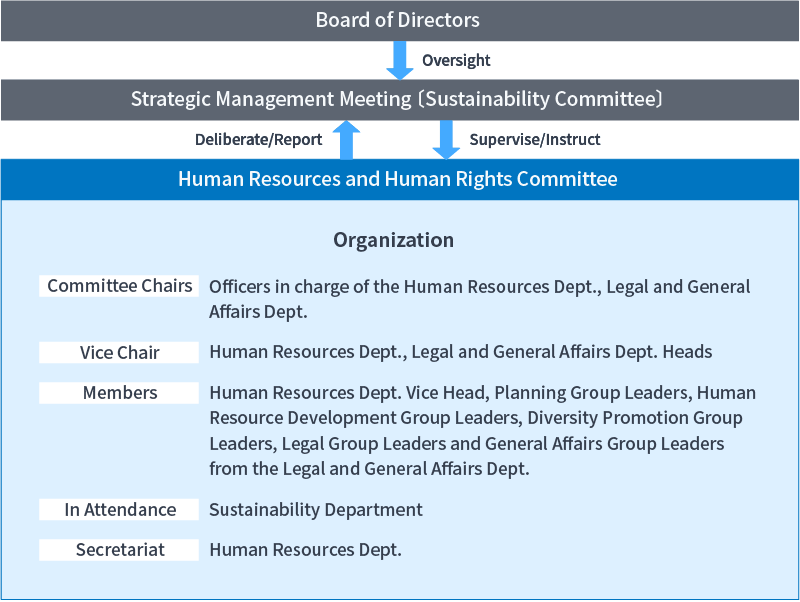
To strengthen the Group-wide promotion of human resource management, respect for human rights, and human rights due diligence, we established the Human Resources and Human Rights Committee, which is led by officers in charge of the Human Resources Dept. and Sustainability Dept. This committee deliberates and reports on matters to Strategic Management Meetings (Sustainability Committee), which are chaired by the President.

The Human Resources and Human Rights Committee is an interdepartmental organization in the UBE Group that identifies risks to the Group related to human resource management, respect for human rights and human rights due diligence. While deliberating and making decisions on response policies, it also sets goals that it manages and promotes.

Human Capital Management Operation System

Targets and Performance

Target FY2025 Results
Continue to carry out human rights due diligence and establish supervision over Group companies (Held the UBE Group Human Rights Month, human rights interviews, etc.)

Initiatives

Human Rights Due Diligence Initiatives

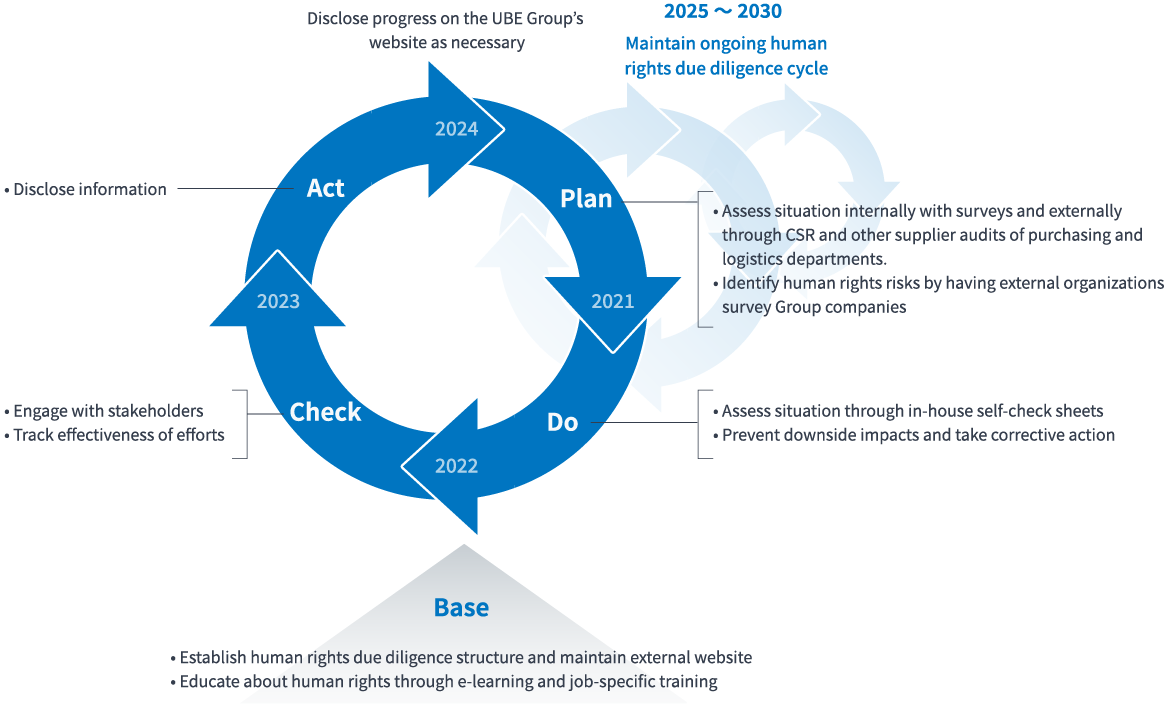
In line with its duty to respect human rights, the UBE Group identifies negative impacts on human rights in its corporate activities and takes action to prevent and mitigate such impacts. Specific initiatives are as follows.

Human Rights Due Diligence Progress
Contents Specific initiatives Results and future measures
Construct a management system for promoting respect for human rights Established a Talent & Human Rights Committee in fiscal 2024 and created a framework for deliberation and reports to the Strategic Management Meeting (Sustainability Committee), which is chaired by the President Formulated fiscal 2024 action results and fiscal 2025 action plans to deliberate upon and report to the Strategic Management Meeting. Set out action plans and KPIs for material issues for each of the following fields: 1. Talent management, 2. Enhancing engagement, 3. Collaboration with Group companies, 4. HR operations, 5. Promoting DE&I and respect for human rights, and 6. Globalization. KPIs for material issues are published online.
Identifying risks to the UBE Group Of the 26 types of human rights risks corporations are responsible for, there have been revisions to laws and regulations within Japan regarding “8. Harassment Related to Such Laws as the Act on Childcare Leave, Caregiver Leave, and Other Measures for the Welfare of Workers (Care Harassment),” “17. Discriminatory Measures and Remarks,” and “18. Gender (including Sexual Minorities)-related Problems.” Identified human rights risks caused by lack of awareness on the Company side among all staff As a result of identification, it was made clear that working environments could give rise to harassment related to inadequate understanding of reasonable accommodations for persons with disabilities, inadequate understanding of LGBTQ+ issues, and the taking of childcare/family care leave if thorough efforts were not made to spread awareness of these points. As such, the Company created e-learning targeting the three themes of mandatory reasonable accommodations for persons with disabilities, further understanding of LGBTQ+ issues, and prevention of adverse treatment of individuals burdened with family nursing, and encouraged attendance at courses, including by Group companies in Japan. In addition, revisions were made to handbooks supporting balancing childcare and family care leave with work.
Future measures will include training sessions on the employment of persons with disabilities, expanding the scope of employees eligible to receive celebratory funds for weddings, and enhancing responses at childcare/family care consultation desks to mitigate human rights risks.
Engaging with stakeholders Plans were made for annual initiatives related to educational activities, with the Company acting as the lead managing company of the Ube/Sanyoonoda District Corporate Human Rights Education Liaison Council Results of educational activities: Conducted training sessions related to Dowa problems in July (Subject: Dowa Problems—Engaging with Various Perspectives on Human Rights Issues. Participants: 37 companies, 67 people), training sessions related to mandatory reasonable accommodations for persons with disabilities in November (Participants: 37 companies, 79 people), visits to corporations conducting LGBTQ+ initiatives in January (Participants: 5 coordinators, 2 secretariats), training sessions related to LGBTQ+ issues in February (Subject: Considering the Diversity of Gender—Fundamental Knowledge of LGBTQ+. Participants: 28 companies, 49 people)
Sharing the status of initiatives and issues with major overseas locations For our major overseas locations, we utilize the Self-Assessment Checklist from the UN Guiding Principles Reporting Framework to confirm progress at each location and share the contents of specific initiatives. We will continue to research the horizontal deployment of initiatives while considering the legal and cultural backgrounds of each country. Continued evaluations of the horizontal development of initiatives while keeping in mind the legal and cultural backgrounds of each country
Tracking the effectiveness of efforts Verified the status of notifications related to human rights in our notification systems (external and internal) 0 external case notifications, 14 internal case notifications. These 14 cases were improved through internal guidance
Specifying respect for human rights in our procurement guidelines and conducting supplier inspections For information on supply chain management, please refer to “Sustainable Procurement
Human Rights Due Diligence Process

Human Rights Education

We created a Group-wide framework to provide ongoing education for employees about human rights based on the UBE Group Basic Policy for Human Rights. In fiscal 2024, HR and Labor Liaison Councils at Group companies discussed risks of human rights violations due to insufficient awareness or measures after legal revisions and conducted e-learning across the UBE Group as part of Human Rights Week.

Human Rights Education Results (fiscal 2024)
e-learning Number of participants: 6,613
(Consolidated Group companies in Japan, including directors)
Number of people targeted: 6,857 (Attendance rate: 96.4%)
New employee training 46 people (UBE, non-consolidated)

Compliance Hotline for Human Rights Issues

In cases where a human rights infringement is revealed through internal reporting, business reports, or other channels, the UBE Group takes prompt action to correct the situation and administers the appropriate internal discipline. In addition, the Group reports such cases to management and disseminates this information throughout the Group to improve its efforts to ensure respect for human rights and to prevent recurrence.

Human Rights Initiatives in Supply Chains

The UBE Group Sustainable Procurement Guidelines, which include measures to address human rights, apply to all Group business partners in order to ensure that human rights are respected throughout the entire supply chain. The Guidelines clearly state that the Group will not tolerate any inhumane acts, including forced labor, child labor, or human trafficking.

In accordance with these guidelines, the Group assesses risks from the perspective of sustainability by conducting regular surveys of its major business partners. The Group also works with business partners to address such human rights issues as labor conditions and the risk of human rights infringement.

The fifth business partner sustainability surveys revealed that suppliers have implemented a certain level of initiatives and measures pertaining to the human rights issues covered by the survey.

For more information, see Supply Chain Management and Results of the Fifth Survey of Business Partners.