Social Talent Management

Policy and Basic Mindset

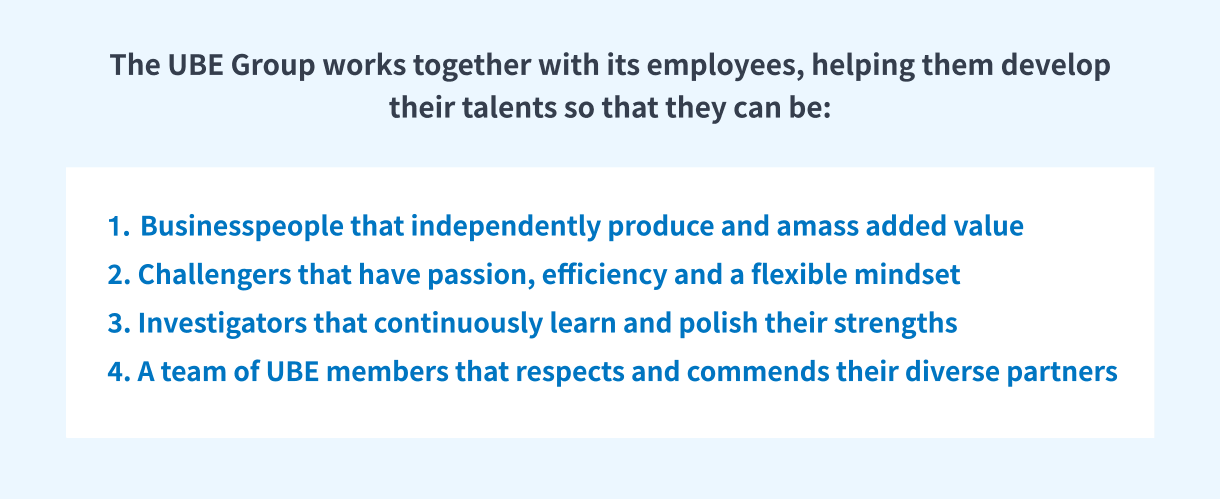
UBE Group Basic Policy for Human Resources Management

In order to enhance corporate value and achieve the maximum well-being of employees, the UBE Group promotes diversity, equity and inclusion (DE&I), advances the empowerment of women, encourages the active participation of senior and foreign employees, promotes the employment of people with disabilities, and provides a rewarding workplace for all employees.

Aligned with our business strategy for the sustainable enhancement of corporate value, our human resources management strategy focuses on developing Talent Models that drive the specialty chemicals and on fostering employees capable of self-directed career development. We aim to build a corporate culture that fosters innovation.

Scope

This policy applies to the UBE Group (UBE Corporation and its consolidated subsidiaries). The human resources management strategy applies to UBE Corporation.

Goal

By enhancing diversity, we aim to build a corporate culture where people with various perspectives and experiences gather, demonstrate their abilities, revitalize the organization, and drive innovation. To achieve this, we will implement the following measures.

  1. We value the diversity of our human resources and respect the individuality of each person.
  2. We foster creativity and autonomy among employees and enhance motivation.
  3. We provide all employees with opportunities to develop professional skills.
  4. We aim for fair evaluation and remuneration.
  5. We will embrace diverse work styles and strive to maintain and improve an inclusive working environment.

Commitment

By 2030, we will achieve the following targets.

  • Percentage of women in management positions (consolidated companies in Japan): 10%, Percentage of women in the workforce (consolidated companies in Japan): 25%
  • Percentage of employees with disabilities (UBE Corporation, Libertas Co., Ltd., Ube General Service Co., Ltd.): 3.2%
  • Investment in off-the-job training per person (UBE Corporation): 300,000 yen or more
  • Employee turnover rate (UBE Corporation): 2% or less
  • Percentage of male employees taking 20 days or more of childcare leave (UBE Corporation): 50%

Responsible Departments and Review

The Human Resources Department and Talent Strategy Department are responsible for overseeing and managing this policy.

This Policy is subject to regular review at least once every year. Any revisions, whether as part of a scheduled review or required during the fiscal year, will be deliberated and approved by the Human Resources and Human Rights Committee.

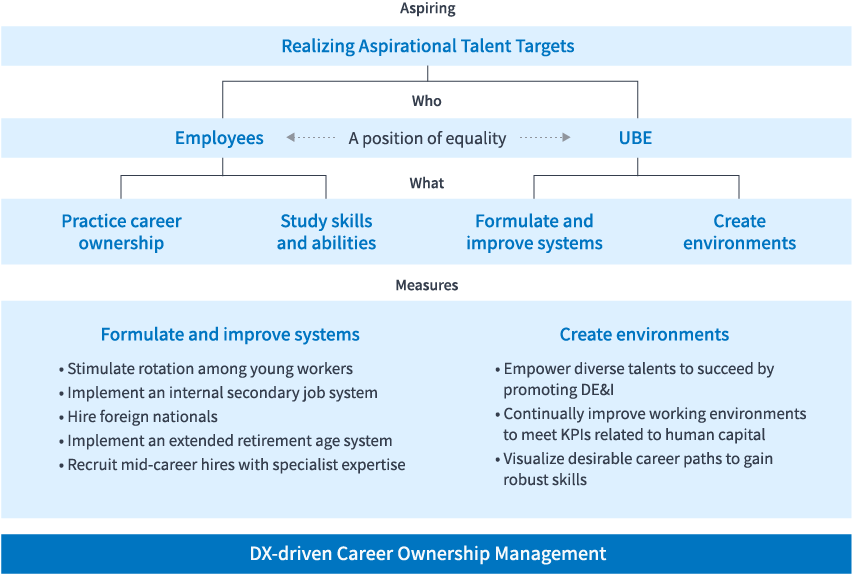
Basic Mindset Toward Our Talent Strategy to Promote Growth in Specialty Chemicals

1. Utilizing Our Talent Strategy in Tandem with Our Management Strategy

In the midst of a rapidly changing management environment, we must formulate and make use of a talent strategy that functions together with our management strategy to support a continued rise in corporate value.

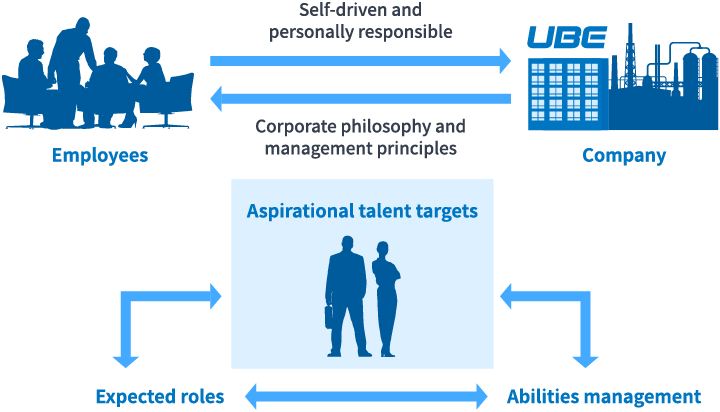
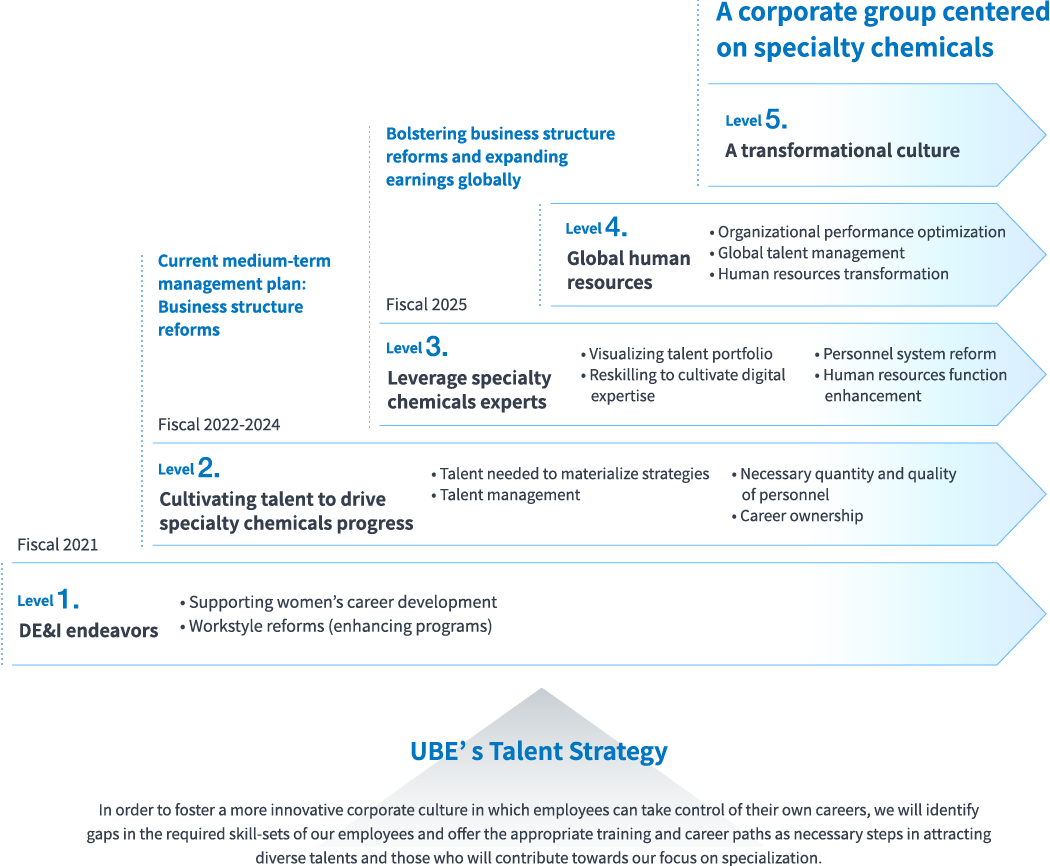
To promote our growth into a corporate group centered on specialty chemicals, we have formulated a five-level talent strategy to undertake such initiatives. Under our current medium-term management plan, which corresponds to Level 3 of the talent strategy, we are developing high-level talent that can work to deepen our reforms to business structures and respond to sudden global developments. We are actively enacting measures to ensure these personnel can act in such cases.
figure

2. Ten Personnel to Promote Growth in Specialty Chemicals

Under the previous Medium-Term Management Plan, we enacted entirely new initiatives to reform business structures and promote DX and evaluated our talent strategy with an eye to putting in place measures to maximize our utilization of human resources.

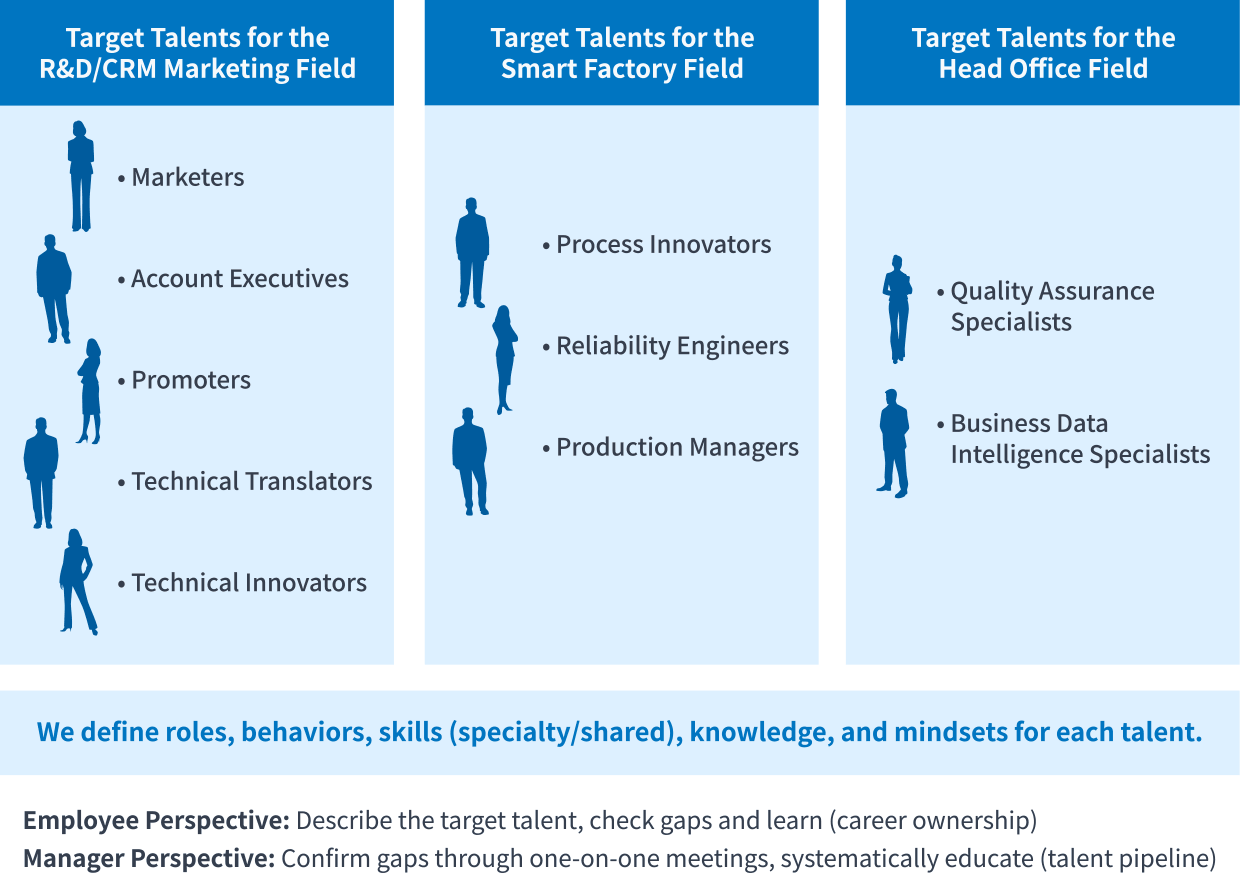
For instance, we engage in discussions on the development of proactive talent that will contribute to achieving the Company’s target of continuous growth in specialty chemicals. As such, we have defined a staffing model dubbed “Ten Personnel.” We will spread awareness of this model among employees in fiscal 2025.
Ten Personnel Overview
figure

3. Talent Management

Having introduced a talent management system, we have been able to create a visualization of our personnel contingent. Using this, we created a talent portfolio through interviews to determine the need for specific types of talent (the Ten Personnel) in each department within each business. This process has revealed the importance of effectively integrating development, hiring, and placement efforts to secure the optimal talent.

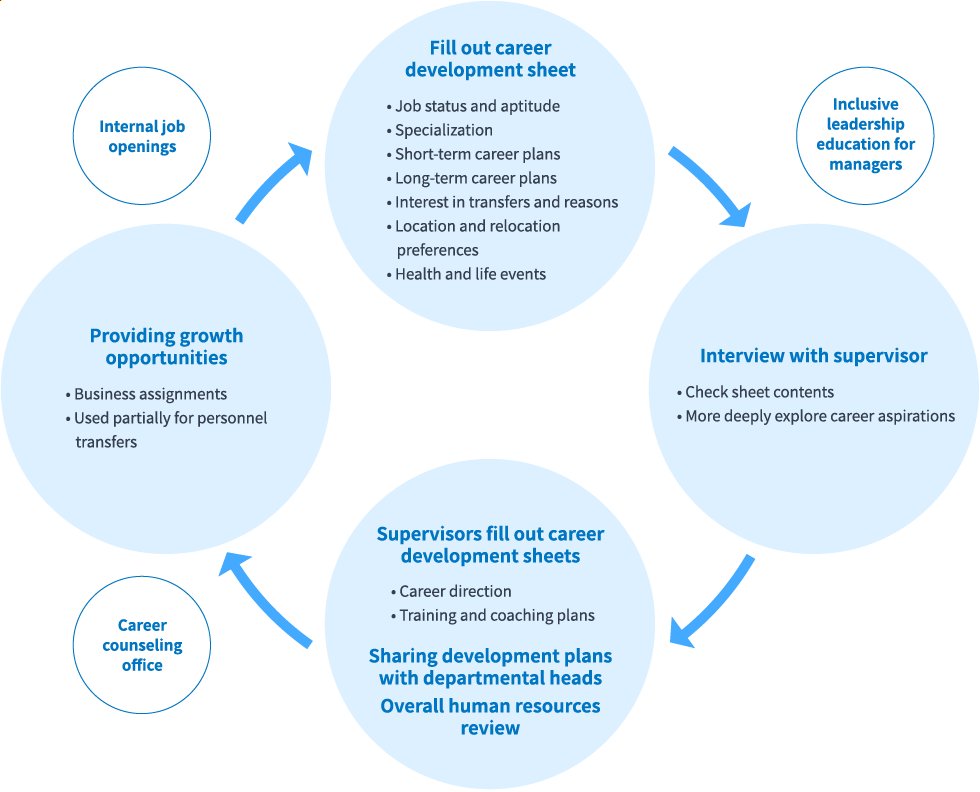
In addition, we are actively conducting internal recruiting with the aim of establishing career ownership, our core talent strategy. This approach provides opportunities for individual employees to consider their own careers while making career plans clearer through our conventional manager-led career development interviews as we conduct internal recruitment year-round.

Moreover, through efforts led by the DX Promotion Office that make full use of generative AI to improve operational efficiency and data usage, we will provide development opportunities for all staff to become digital talent. Our promotion of DX encompasses not only the use of digital technologies but the integration and streamlining of operations while bringing together technologies to create value. We are promoting DX across the Company from this perspective.

4. New Personnel System

We are reforming our personnel system with the aim of commencing operations in fiscal 2026. We strive to have staff consider their own personal growth and which of the previously defined Ten Personnel they aim to be as we build a framework to encourage autonomous career and specialist development. Specifically, we are unifying career-track employees and key employees without regard for age or educational background under a system that evaluates how they can best utilize their abilities when exercising their duties. We will also realize reforms by creating a framework for properly handling personnel who possess advanced specialties.
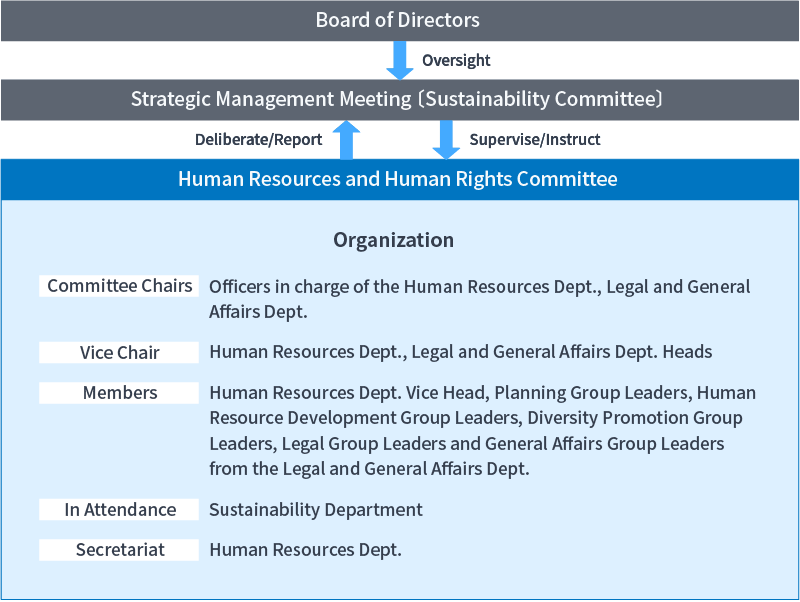
Management System

Human Capital Management Operation System

Targets and Performance

Indicator Scope FY2024 FY2025 FY2030 (Mid- Long-Term)
Results Targets Targets Targets
Amount invested in talent per person UBE (non-consolidated) ¥205,000 ¥200,000 ¥300,000

Status of Important Policies and Progress

We believe that an environment in which diverse perspectives and values can intermix is necessary for continuous organizational growth. Exchanges among talent with differing experiences and specialties give rise to innovative ideas and new discoveries, outcomes that nurture our ability to notice signs of change more quickly. To reinforce this structure, we set clear KPIs in the field of human resources and prepare working environments and systems. On a quarterly basis, we verify the progress of these KPIs across the UBE Group and visualize and share our results to ensure the unity and effectiveness of Company-wide initiatives.

Fiscal 2022–2024 Results for Human Resources-Related KPIs (Consolidated Domestic)
(FY) Results
2022 2023 2024
Ratio of women in managerial roles 4.10% 4.60% 5.80%
Ratio of women in the workforce 15.00% 15.00% 16.00%
Ratio of mid-career hires (generalist) 37.30% 36.10% 51.30%
Foreign nationals hired 0 7 5
Take-up rate of childcare leave among male employees 99% 86.90%
Take-up rate of annual paid leave 74% 81% 81.30%
Ratio of persons with disabilities in the workforce 2.70% 2.68% 2.69%
Smoking rate 23% 23% 22.30%
Human Resources-Related KPIs and Targets for Fiscal 2030
(FY) Targets
2025 2030
Amount invested in talent per person (UBE, non-consolidated) ¥200,000 ¥300,000
Ratio of women in the workforce (domestic consolidated) 17.00% 25.00%
Ratio of women in managerial roles (domestic consolidated) 6.50% 10.00%
Ratio of persons with disabilities in the workforce (UBE/Libertas Ube/UBE General Service) 2.70% 3.20%
Turnover rate (UBE, non-consolidated) Less than 1.1% Less than 2%
Take-up rate of annual paid leave (UBE, non-consolidated) 95% 100%
Total actual working hours (UBE, non-consolidated) 1,900 Less than 1,880
Ratio of male employees taking more than 20 days of paid childcare leave (UBE, non-consolidated) Over 30% 50%

Initiatives

1. Dialogue with Employees

Through candid exchanges of ideas between top management (the President) and employees, UBE conducts initiatives to deepen mutual understanding of issues at each workplace and future trends.

In fiscal 2024, these meetings were conducted a total of 14 times with 51 participants encompassing candidates for management positions. Here, active discussions took place regarding visions for the future of UBE.

2. Talent Education

1. Talent Education

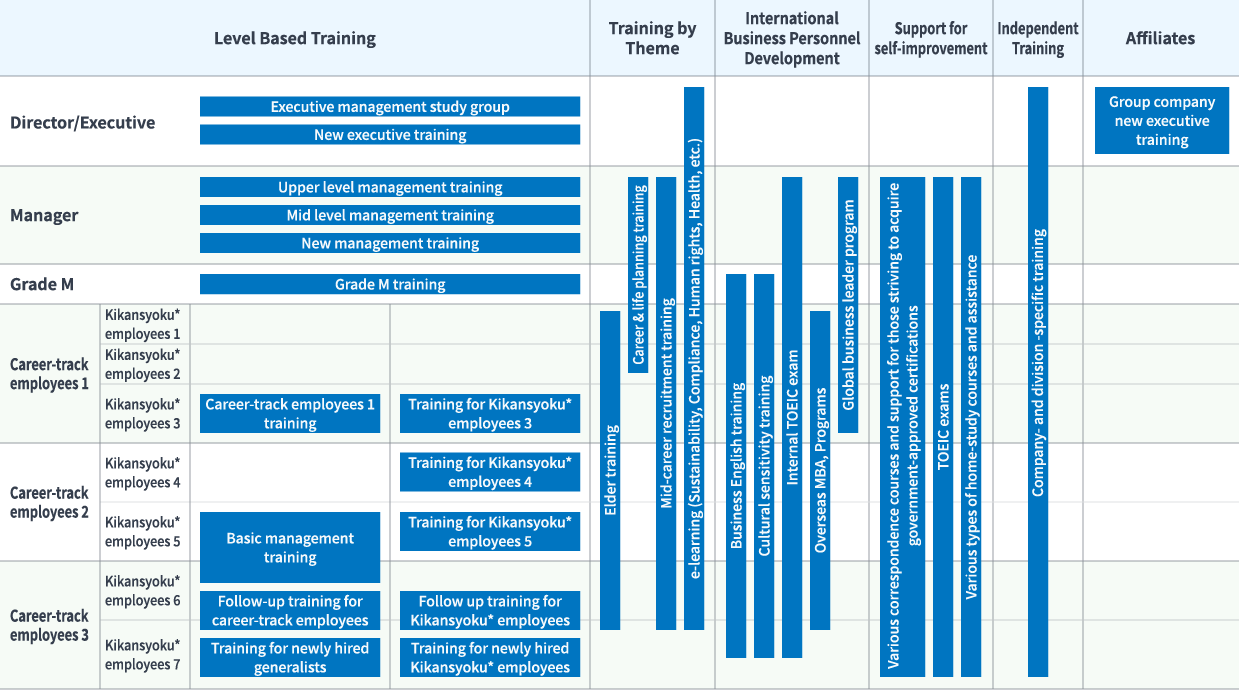
By expanding investments into talent education, UBE works to develop talent who can handle growth and reforms. To encourage internal communication, we hold a portion of training sessions in-person rather than within the usual online framework with the aim of maximizing efficiency and results.

figure

In addition, we utilize outside e-learning services when conducting level-based training to create a culture in which self-motivated individuals continue to seek growth as they strive for career autonomy.

In order to develop human resources who can work in a diverse business and globalized environment, the following approaches have been strengthened.

  • OJT (on-the-job training)
  • OFF-JT (off-the-job training: group training, etc.)
  • Self-development support system

Through these approaches, UBE is actively working to develop human resources so that each and every employee can fully demonstrate his or her abilities through work.

In OFF-JT, we conduct training programs to develop the abilities needed at each stratum and position while reflecting the changes in the outside environment. To aid in self-improvement, we utilize various programs, such as correspondence courses as well as internal and external language courses, to support employees as they improve their abilities.

Investment per person/training hours per person
(FY) UBE Co.
2022 2023 2024
Investment in off-the-job training per person*1 ¥120,000 ¥150,000 ¥205,000
Training hours per person*2 17 19 15*3
  • *1Calculation methodology: (Total education and training expenses + Labor costs for department overseeing training)/Number of employees on non-consolidated basis (as of fiscal year-end)
  • *2Calculation methodology: (Total hours of group training + Total hours of e-learning)/Number of employees on on-consolidated basis (as of fiscal year-end)
  • *3Due to the effect of integrating API Corporation
Outline of Training System

2. Practical Education

Practical education at UBE is done from a different perspective than the level-based training provided equally to all employees and involves a system of individually oriented targeted education especially focused on differentiating talent. The Talent Strategy Dept. and Business Dept. work together to educate the talent they need in coordination with management. For a specific example in the sales area, lecturers choose guests who have a background in automotive OEM design or other such specialty to play the role of customers and engage learners in highly charged sales conversations. These efforts deepen the negotiating capabilities of staff in these areas. Such efforts take only a short time to be effective and allow individuals to gain needed skills.

3. Enhancing Global Human Resources Development

The UBE Group actively works to develop human resources that can contribute to its growing international business in various domains. To improve linguistic capabilities, we have begun to have all employees take the TOEIC exam, designating target points in English ability for each test. Also, we select trainees for dispatch overseas from among those who voluntarily apply and those put forward via departmental referrals. In addition, we conduct global business leader training with the goals of strengthening the ability of our employees to interact with other cultures and develop a global mindset among themselves while proactively expanding their opportunities for overseas experience.

figure

4. Talent Management through DX

We have defined the “10 Target Talents” (roles, skills, knowledge, behaviors, mindsets) needed to promote our transition to being a corporate group centered on specialty chemicals. Accordingly, we are putting effort into internal recruitment systems to allow autonomous individual development so that employees are encouraged to take ownership of their career paths. We have also introduced a talent management system with the aim of creating a framework for the systematic education of the talent needed to achieve our business goals.

3. Increasing Job Satisfaction

By establishing a talent database and introducing a talent management system, UBE has enhanced its HR-related operations even as it continues to provide systematic talent education. In particular, active internal recruitment supports individual employees in taking ownership of their careers and injects vitality into the talent pool. We are creating new systems for evaluating how well employees utilize their abilities in the course of their duties regardless of age or educational background and other systems to ensure the appropriate handling of high-level specialists. In all these endeavors, we strive to enhance well-being by fairly evaluating employees.

At the same time, we are standardizing the use of preferred names and respecting employee identities to create comfortable workplaces.

figure

Issues and Responses to Enhance Well-Being

In fiscal 2024, a well-being survey covering all employees was conducted at UBE in collaboration with the labor union. Results of this survey are viewed as indicators. Particular attention was paid to deviations in workplace well-being attributable to differences in age, job type, and work assignment. Based on an analysis of these results, along with the results of staff interviews, we are reviewing and developing the contents of measures to improve employee satisfaction. In fiscal 2025, we established the Labor-Management Review Committee and are engaging in mutual discussions on raising indicators related to happiness in the workplace. In all these efforts, we are striving to ensure that individual employees feel respected, and, by encouraging their desire for growth, belonging, and contribution, we strive to foster a company culture that makes it is easy to achieve innovation.

4. Analysis of Productivity Increases

We continue to create environments that enable flexible workstyles so that the diverse employees at UBE are able to utilize their abilities to the greatest possible extent. We are promoting shorter working hours as a part of these efforts. In addition, we utilize per-capita profit indicators in our system for performance-based bonuses to maximize results through enhanced productivity. By sharing this awareness with all employees, we strive for further leaps in pursuit of continuous growth.

Individual Consolidated Ordinary Profit and Individual Total Actual Working Hours
  • Notes:
  • 1.Individual Consolidated Ordinary Profit is calculated without factoring in losses from the machinery business or UBE Mitsubishi Cement Co.
  • 2.Values for fiscal 2023 include employees at business partners.