Social Health Management

Health Management Declaration

The UBE Group holds its Purpose to be “Breaking Through with the Chemistry of Hope,” and, based on its slogan for change of “Facing the challenges of an uncharted future,” continues to challenge itself to realize continuous growth. As a further step in this direction, we feel that it is important to act in such a way that each and every person with a relationship with the UBE Group feels as though they are being treated as important.

We hereby announce that we are conducting health management through investments into health so that UBE Group members and their families can feel at ease, safe, and happy. By promoting the management of well-being, we are working to create systems that allow employees to be fulfilled by their work and face the challenges of the future.

Yuki Nishida

UBE Corporation President & Representative Director

Based on the philosophy that health and safety are foundational to both corporate and union activities, the UBE Labor Union is developing activities that encourage each union member to actively engage in maintaining their health.

Through cultural and sports activities, various seminars, and educational activities, we encourage the creation of exercise habits, and we are also working to build mutually supportive relationships through dialogue at work locations and relaxed consultations.

In accordance with the ideal of “Breaking Through with the Chemistry of Hope,” we are aiming to realize workplaces built on environments where people feel at ease, safe, and happy and in which every individual can confidently face the challenges of the future. Through health management, we will come together to create workplaces where everyone can work energetically.

Masashi Miyao

UBE Labor Union Chairman

Policy and Basic Mindset

UBE Group Basic Policy for Health Promotion

By promoting investment and management for health, the UBE Group strives to maintain and improve employees’ health and create a work environment where employees can work with a sense of safety, security, and well-being.

Scope

This policy applies to the UBE Group (UBE Corporation and its domestic consolidated subsidiaries).

Goal

We will promote investment and management for health to ensure everyone involved in the UBE Group—regardless of generation, role, nationality, or work style—can experience safety, security, and well-being, while enhancing the value of human capital. To achieve this, we will implement the following measures.

  1. We will establish and operate a system for the Group's five occupational health management areas (work environment management, work management, health management, occupational health education, and comprehensive management) to provide safety and security to all employees working in the UBE Group.
  2. We aim to create an organization that maximizes labor productivity by ensuring job satisfaction and well-being for all employees working in the UBE Group.

Commitment

  • By FY2030, we aim to achieve an A rating on the presenteeism assessment (WFun) for UBE Corporation (non-consolidated).

Responsible Departments and Review

The Health Promotion Center, Human Resources Department is responsible for overseeing and managing this policy.

This Policy is subject to regular review at least once every year. Any revisions, whether as part of a scheduled review or required during the fiscal year, will be deliberated and approved by the Group Health Promotion Committee.
Management System

System for Promoting Health Management

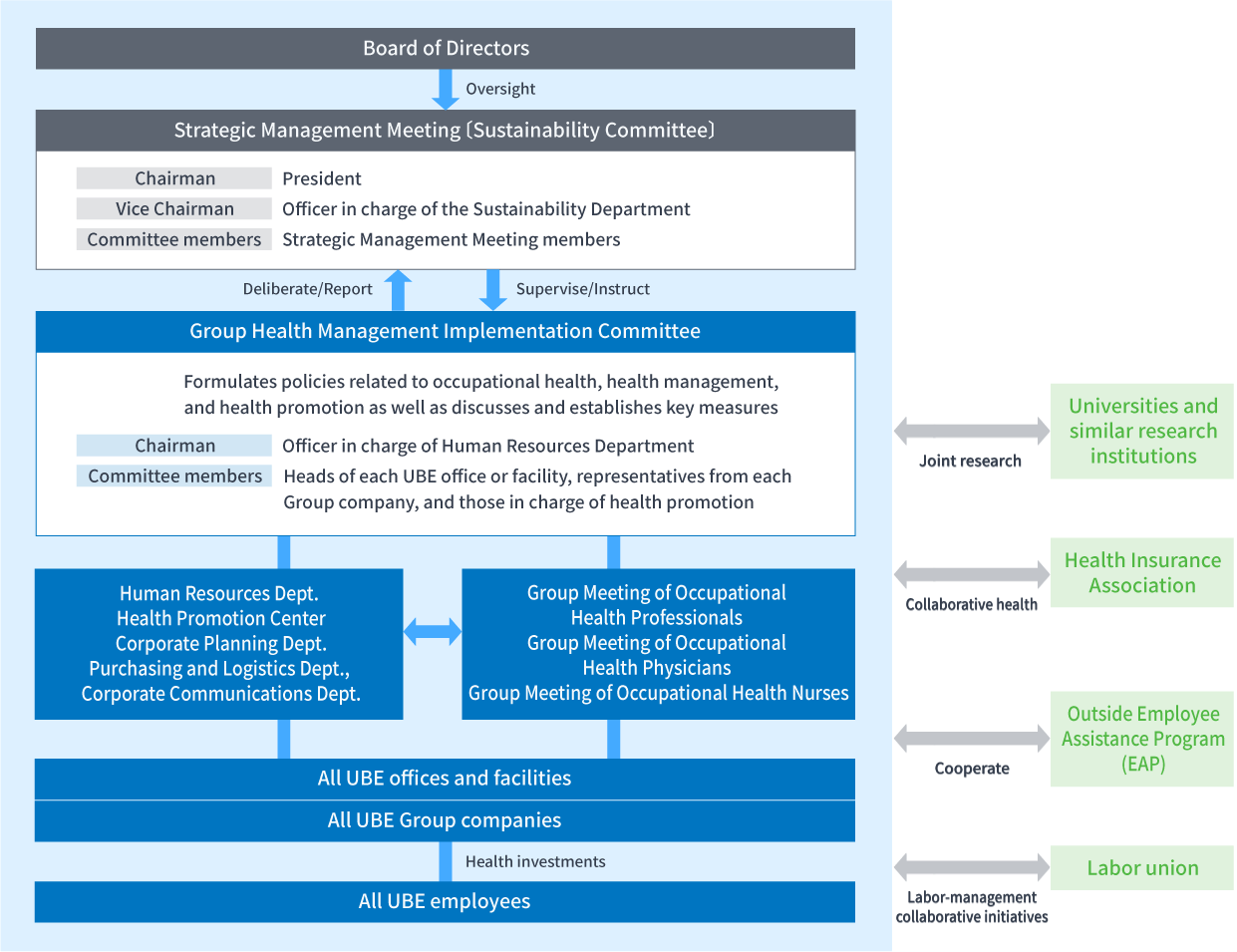
  • The UBE Group considers basic policies and measures for promoting health to be top management priorities. These management priorities are reviewed and established at Strategic Management Meetings (Sustainability Committee) chaired by the President, with oversight from the Board of Directors.
  • The Group Health Management Implementation Committee, one of the specialized committees under the Strategic Management Meeting (Sustainability Committee), discusses basic policies related to health management and promotion as well as medium- to long-term plans and key items to be carried out each fiscal year. The content of these discussions is then reviewed and measures are established by the Strategic Management Meeting (Sustainability Committee).
  • The content of discussions held by the Strategic Management Meeting is distributed across the entire Group. In doing this, and to ensure efficient operations, we utilize three meetings: the Group Meeting of Occupational Health Professionals, the Group Meeting of Occupational Health Physicians, and the Group Meeting of Occupational Health Nurses. These committees also drive various initiatives.
  • At all of our offices and facilities, we have established a General Health Manager System that is unique to the UBE Group. Under this system, occupational health professionals , occupational health physicians , and occupational health nurses collaborate in identifying issues based on analyses on various kinds of data. These professionals additionally strive to maintain a safe, secure, and comfortable environment in which employees can find meaning in their work.
  • In partnership with health insurance associations, UBE is working to strengthen preventive measures for serious illnesses, enhance specified health guidance measures, and support general collaborative health measures. We also work with external organizations, engaging in joint research projects with universities and research institutions, while actively utilizing outside Employee Assistance Programs (EAPs)*.
  • *Outside Employee Assistance Programs: Support from external specialist organizations for employees experiencing mental health issues, with the goal of enhancing organizational vitality.
Health Management Promotion System

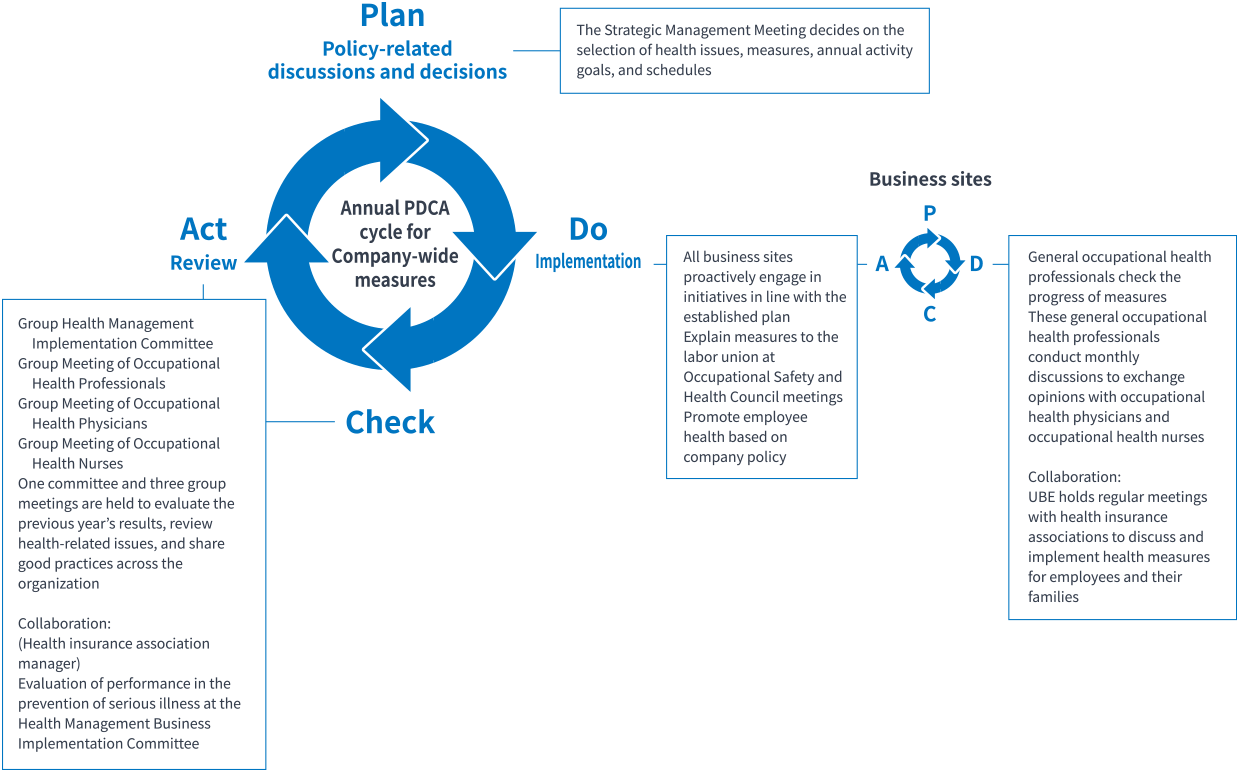
Each business site implements activities using Plan-Do-Check-Act (PDCA) cycles in order to ensure continuous improvement of health promotion

Annual PDCA cycle for Company-wide measures

Targets and Performance

Key Issues

As one of its key issues related to health management, UBE is working to reform presenteeism as it strives to cultivate attitudes that are emotionally and physically healthy as well as highly productive with regard to work. We are measuring the extent to which health problems affect worker productivity and striving to identify the symptoms that have the largest effect in order to effectively reform presenteeism. (For details on initiatives, please refer to “5. Presenteeism” under “Initiatives”)

Metrics Scope FY2024 FY2025 FY2030
Results Targets Targets Targets
Presenteeism (measured by WFun*) UBE (non-consolidated) B B B A
  • *WFun: A tool for measuring presenteeism provided by SOMPO Health Support

In addition, we have positioned anti-smoking measures as a key issue and have set targets for smoking rates that we are promoting across all consolidated Group companies in Japan. (For details on initiatives, please refer to “2. (2) Anti-Smoking Measures” under “Initiatives”)

Metrics Scope FY2024 FY2027 FY2030
Results Targets Targets Targets
Smoking rate Consolidated companies in Japan 22.3% Less than 20% Less than 17% Less than 12%

Other Metrics and Results

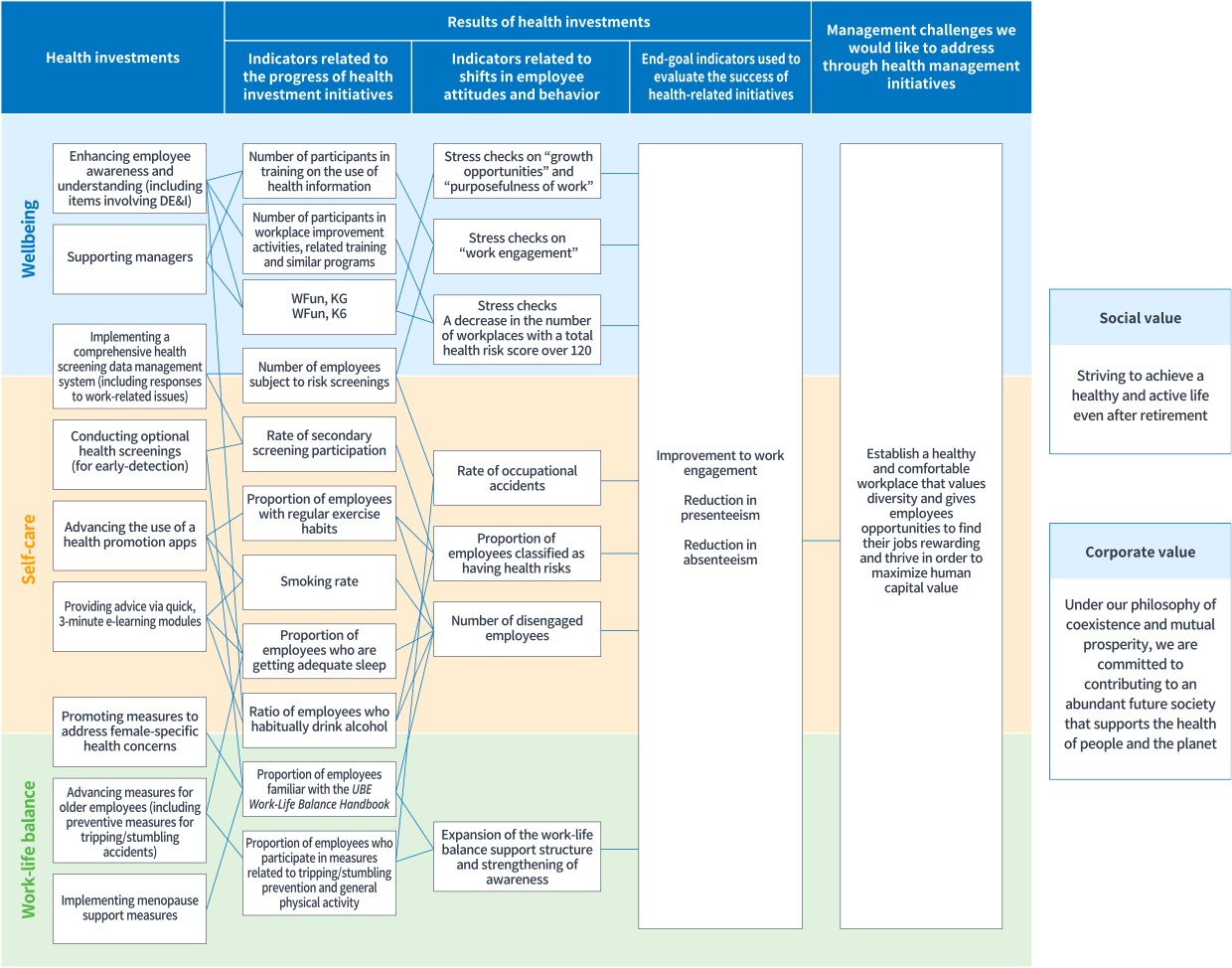
We have also formulated a strategic map for health management with an eye to undertaking health investments in ways that will reduce absenteeism, reform presenteeism, and enhance work engagement and are evaluating the effects of initiatives through various metrics.

Issue Item Scope FY2022
Results
FY2023
Results
FY2024
Results
FY2025
Targets
Utilize health check results to understand brain and heart disease risks and reduce the rate of occurrence of abnormal findings Rate of attending regular health checks UBE (non-consolidated) 100% 100% 100% 100%
Rate of attending detailed examinations UBE (non-consolidated) 99.4% 99.1% 98.6% Higher than the previous fiscal year
Ratio of high-risk individuals according to UBE standards UBE (non-consolidated) 7.6% 8.4% 7.7% Lower than the previous fiscal year
Utilize health check results for early discovery and treatment of malignant neoplasms Rate of attending secondary examinations for cancer screening UBE (non-consolidated) 99.0% 97.0% 95.7% Higher than the previous fiscal year
Utilize stress check results to promote activities to improve workplaces Rate of attending stress checks UBE (non-consolidated) 93.5% 96.3% 96.5% Over 95%
Number of departments with a total health risk value above 120 UBE (non-consolidated) 20 19 23 Lower than the previous fiscal year
Ratio of high-stress individuals in stress checks*1 UBE (non-consolidated) 11.5% 9.1% 10.5% Lower than the previous fiscal year
Reducing the number of individuals on long-term leaves of absence Rate of new patient incidence UBE (non-consolidated) 0.72% 0.85% 0.48% Lower than the previous fiscal year
Rate of severity of mental health issues*2 UBE (non-consolidated) 0.60% 0.77% 0.90% Lower than the previous fiscal year
Rate of return to work UBE (non-consolidated) 36.7% 37.8% 35.5% Over 50%
Zero secondhand smoke Smoking rate UBE (non-consolidated)*4 19.6% 19.9% 21.2% Under 20%
Domestic consolidated companies 22.7% 23.0% 22.3%
Other health indicators (Target: health examinees of all ages) Rate of appropriate body weight UBE (non-consolidated) 66.9% 66.9% 66.1% Higher than the previous fiscal year
Ratio of persons who exercise regularly*3 UBE (non-consolidated) 37.9% 37.8% 33.5% Higher than the previous fiscal year
  • *1Ratio of high-stress individuals in stress checks: Rate of high-stress individuals according to the MHLW’s Stress Check Guidelines (revised August 2018)
  • *2Rate of severity of mental health issues: (Total number of working days lost / Total actual working hours) * 1,000
  • *3Ratio of persons who exercise regularly: Ratio of individuals who exercise at least 30 minutes two or more times a week
  • *4Smoking rate at UBE (non-consolidated) and consolidated companies in Japan: Combines increases and decreases at targeted Group companies as well as consolidated Group companies in Japan that have merged into UBE

UBE Health Management Strategy Map: Created April 2025

Strategy Map
  • *Partially revised in fiscal 2025

Initiatives

1-1. Initiatives to Raise Employee Awareness and Understanding of Health Management

As an initiative to raise employee awareness and understanding of health management, the president, who is responsible for health management, and the chairman of the UBE labor union jointly issued a Health Management Declaration. The Health Management Declaration is posted on the top page of the company intranet to encourage employees to be more aware of health management issues.

We have also created a health management slogan. Group-wide, we invite employees to submit slogan ideas, with the top entries being officially recognized by the President at safety and health rallies. Our slogan for fiscal 2025 was “Health is your asset and a Company asset, so let’s manage our health together.” This slogan is displayed on posters at all offices and facilities across the UBE Group, with the aim of raising employee awareness and understanding of health management.

1) Awareness of health management

We periodically conduct surveys regarding employees’ familiarity with health management initiatives to gauge overall levels of awareness. In fiscal 2024, awareness levels reached 98.6%.

Item September 2022*1 October 2023*2 December 2024
Response rate (UBE, non-consolidated) 50.1% 64.7% 97.4%
Awareness of health management (UBE, non-consolidated) 97.7% 98.9% 98.6%
  • *1Results obtained from roughly half of employees
  • *2Results obtained from approximately 65% of employees

Awareness surveys conducted by the labor union and provided to all union members showed a strong degree of awareness of health management measures and issues at each worksite, and we are conducting discussions among labor and management at the Occupational Safety and Health Councils at all Group companies and locations.

2) External evaluations

As a result of promoting health management at all Group companies, UBE as well as a total of 13 of its consolidated subsidiaries in Japan were recognized as outstanding organizations under the Certified Health & Productivity Management Outstanding Organizations Recognition Program developed by METI and Nippon Kenko Kaigi in fiscal 2024. Within this group, UBE Logistics Service, Ltd. and Fukushima, Ltd. were included in the Bright 500, while T&U ELECTRONICS CO., LTD. and Ube General Service Co., Ltd. were included in the newly established Next Bright 1000.

The Group Health Management Implementation Committee, alongside three meetings (Group Meeting of Occupational Health Professionals, Group Meeting of Occupational Health Physicians, and Group Meeting of Occupational Health Nurses), all strive to horizontally roll out good practices to be undertaken at each company and are improving the level of health management across the entire Group.

  • *Health management is a registered trademark of the NPO Kenkokeiei.

2. Physical health

1) Health checks and health guidance

UBE conducts efforts including health checks and providing health guidance through experts in occupational health to support employees in health management.

The rate of attendance at the regular health checks provided across UBE continues to be 100%. We actively recommend attendance at complete examinations, and in fiscal 2024 the rate of attendance at these was 98.6%. We are also expanding optional items, such as all types of cancer screenings, creating an environment in which it is easy for women to attend cancer screenings held internally for breast and cervical cancer. In addition, we operate a cooperative business with the UBE Health Insurance Association to assist with fees for optional items as well as fees associated with complete medical checkups, brain checkups, ophthalmic fundus examinations, renal function exams, hepatitis tests, bone density exams, dental exams, and more.

Based on the risk standards formulated by UBE regarding brain and heart disease, risks are identified from the results of health checks for all staff, and year-to-year changes are verified. Health guidance is provided for individuals when issues are identified as well as for high-risk individuals, and issues to be improved upon are identified at each worksite. Alongside the UBE Health Insurance Association, we analyze the corporate health score report, sharing concerns about issues and delegating duties while creating plans that reflect this analysis in measures regarding health promotion measures and health management.

Assistance Provided by the UBE Health Insurance Association for Health Checks, Exams, Preventive Vaccines, Etc. (fiscal 2025)
Target individuals Assistance
Fecal occult blood tests Insured persons at age 35 or over 40 Full coverage
Abdominal ultrasound (echo) exams Insured persons at age 40, 45, 50, 55, and 60 Full coverage
Hepatitis B tests Insured persons at age 40, 45, 50, 55, and 60 Full coverage
Hepatitis C tests Insured persons at age 40, 45, 50, 55, and 60 Full coverage
Cervical cancer screening Insured persons over the age of 20 (once every two years) Full coverage
Breast cancer screening (echo) Insured persons over the age of 30 (once every two years) Full coverage
Breast cancer screening (mammography) Insured persons over the age of 40 (once every two years) Full coverage
Abdominal ultrasound (echo) exams at medical institutions Insured persons at age 55 Full coverage
Gastroscopies at medical institutions Insured persons at age 55 Full coverage
Colonoscopies at medical institutions Insured persons at age 55 Full coverage
Various health check assistance
(Aforementioned exams (when full coverage is not applicable), tumor marker tests, ABC exams, complete medical checkups, brain checkups, ophthalmic examinations, renal function exams, hepatitis tests, bone density exams, etc.)
Insured persons/dependents over the age of 35 Covers up to a maximum of ¥40,000/year
Dental check assistance Insured persons/dependents
(Excluding infants/elementary school students/junior high school students/high school students)
Covers up to a maximum of ¥3,000/year
Influenza vaccinations Insured persons/dependents Covers up to a maximum of ¥2,000/visit once for a single individual. However, this can be used twice by children of elementary school age or younger who require two vaccinations.

2) Anti-smoking measures

The UBE Group’s Medium-Term Management Plan for fiscal 2022 to 2024 called for consolidated subsidiaries in Japan to aim for a smoking rate of less than 20% and included such efforts as anti-smoking education for younger employees. UBE has set a workplace regulation that smoking is not allowed at company locations during working hours, and, although we provide an online anti-smoking program as a cooperative business alongside the UBE Health Insurance Association without any out-of-pocket expense paid, we have not been able to reach this goal at UBE (non-consolidated) or at our consolidated subsidiaries in Japan.

We have held new cooperative discussions on the importance of organizational anti-smoking measures and have set our targets for the smoking rate at consolidated subsidiaries in Japan to be less than 17% in fiscal 2027 and less than 12% in fiscal 2030.

In addition, a specific measure at UBE involves prohibiting smoking during all working hours, including during break times (at company sites), when going out, during business trips, and when teleworking as a work regulation after October 2025. We will also take down all smoking sites for employee use at UBE locations.

3. Mental health

UBE utilizes the 80 items on the new Brief Job Stress Questionnaire to conduct annual stress checks. In addition, we provide methods for employees to take the test whenever they would like on our intranet to create an environment where they can practice self-care.

We utilize the results of group analyses to understand issues and conduct dialogue-based positive mental health workshops in collaboration with outside Employee Assistance Programs (EAPs).* We also determine which departments have a total health risk score of above 120 in the stress check and promote activities to improve workplaces in cooperation with occupational health experts and outside EAPs.

  • *Outside Employee Assistance Programs: External specialist organizations that provide support for employees experiencing mental health issues, with the goal of enhancing organizational vitality.

Moreover, we conduct level-based mental health training in which employees at various career stages can deepen their understanding of mental health through easy-to-comprehend examples. Here, we also introduce services that include outside EAPs and professional collaborators at each workplace who are available for consultation in the event of a mental health or other issue occurring. In addition, we conduct interviews for all new employees and mid-career hires one year after they join the Company and make robust follow-up efforts.

Eligible Employees FY2024 Results
Grade-specific training on mental health Newly hired employees, mid-career hires, managers, etc., at UBE Total: 207 employees
Consulting with Outside Employee Assistance Programs (EAPs) UBE employees and their families Average of 12.5 cases per month
Mental health information UBE Group consolidated companies in Japan 24 announcements per year
Postings on intranet
Introducing the Safety and Health Committee

4. Absenteeism

At UBE, we monitor the yearly trends of employees taking leave due to non-occupational injuries or illnesses, while also managing the incidence rate, severity, and return-to-work rate of those suffering from mental health issues.

We strive to conduct analyses of various issues with the goal of preventing them before they occur and are promoting the establishment of return-to-work support systems across the entire UBE Group. We have also established the “Five Steps of Return-to-Work Support” to clarify the procedures from beginning to take leave to follow-up efforts after returning to work. We collaborate with Human Resources and Labor Officers, workplace managers, occupational doctors and nurses, and outside EAPs to verify various matters to be understood across each step and support plans for returning to work in order to aid employees in this process.

We also continue to view work-life balance support as a key issue. We published the UBE Work-Life Balance Handbook in fiscal 2022, which outlines support systems for child rearing, nursing care, infertility treatments, and balancing work responsibilities with medical treatments. This handbook provides clear information for those using these systems and aims to promote understanding among management and colleagues. UBE has set up consultation desks for balancing work responsibilities with medical treatments at all business sites and appointed work-life balance coordinators tasked with creating an environment where employees can easily receive guidance. For balancing work responsibilities with nursing care, we have established consultation desks and strive to comprehend current conditions and needs through surveys. We also provide training that promotes understanding of our systems among employees who have reached the age of 40 to establish an environment where such balancing acts are simple.

Furthermore, on an annual basis we provide five days of life support leave in addition to annual paid vacations. These can be used for a variety of purposes, such as non-occupational injuries and illness, nursing care, caregiving, childcare, morning sickness, infertility treatments, disease prevention efforts (vaccines, cancer screenings, complete medical checkups), community and social contribution activities, and employee or family anniversaries or life events.

5. Presenteeism

A key issue in the Medium-Term Management Plan (fiscal 2025–2027) is improving presenteeism. We aim to connect these efforts to highly productive attitudes among employees that are healthy in mind and body.

Presenteeism is when an employee continues working despite experiencing health issues, leading to a reduction in productivity. As tools to measure this, we introduced WFun*1 and K6.*2 The response rate in fiscal 2024 was 97%.

Along with measuring the degree of loss in workplace productivity due to health issues, we are working to understand which symptoms have the greatest impact on job performance. Results of surveys done between fiscal 2022 and 2024 showed that issues related to sleep, pain, and eye health were among such symptoms, and we continue to enact measures to improve these aspects. Participants of the sleep seminar conducted in fiscal 2024 reported a 97.8% satisfaction rate, while 100% of participants expressed their desire to put at least one of the ideas from the seminar into practice.

  • *1WFun: A questionnaire designed to evaluate the degree of work impairment due to health issues
  • *2K6: A questionnaire designed to evaluate the mental wellbeing of employees
Initiatives in fiscal 2023, 2024, and 2025 (extending to UBE (non-consolidated) and some consolidated companies in Japan)
Sleep
  • Three-minute health advice “Are You Resting While You Sleep?”
  • Sleep seminars from outside lecturers (in collaboration with UBE Health Insurance Association)
  • Sleep apnea syndrome tests (in collaboration with UBE Health Insurance Association)
Pain
  • Three-minute health advice “Measures to Prevent Stiff Shoulders and Back Pain”
  • Stiff shoulders and back pain seminars from outside lecturers attended by UBE employees (in collaboration with UBE Health Insurance Association)
  • Headache seminars for key persons at various worksites from outside lecturers
Eyes
  • Three-minute health advice “Eye Health”
  • E-learning “Eye Health Management”

6. Work Engagement and Well-Being

UBE utilizes the 80 items in the new Simplified Occupational Stress Check Questionnaire to continue to understand trends in work engagement among individuals and workplaces. By utilizing the Health and Vitality Assessment Report* in stress checks, we can relay health information through workplace leaders to conduct initiatives in response to organizational issues.

  • *Health and Vitality Assessment Report: Feedback sheet based on an e-Diagnosis for mental health
Annual Trends in Work Engagement
(New Simplified Occupational Stress Check Questionnaire: Q79 and Q80 in 80 items)
Fiscal Year 2020 2021 2022 2023 2024
Q79 2.2 2.2 2.2 2.2 2.2
Q80 2.7 2.7 2.7 2.7 2.7
  • *Scoring: Agree = 4 points, Somewhat agree = 3 points, Somewhat disagree = 2 points, Disagree = 1 point

The well-being survey provided to UBE labor union members in fiscal 2022 was expanded to target all employees, including managers, at UBE in fiscal 2024. Results were analyzed and after exchanging opinions within the Labor-Management Review Committee, we began promoting measures to enhance work engagement and well-being.

FY2022 results FY2024 results
Well-being survey targets UBE labor union members All UBE employees, including managers
Well-being survey response rate 72% 94%

7. Enhancing health literacy and self/line care

UBE conducts initiatives to promote understanding of diverse health issues and strives to enhance its employees’ health literacy. In fiscal 2024, one of the e-learning themes all employees engaged with was “Learning about Physical and Mental Health from Hormones in Men and Women.” Through this, deeper understanding was gained about gender-based health issues, symptoms of aging, pre-conception care, and more.

In tandem with this, we provide a wealth of measures for individuals to enhance their health autonomously. In collaboration with the UBE Health Insurance Association, we hold walking events using apps and assist with the costs of sports gyms and other facilities with the aim of encouraging the adoption of exercise habits. Assistance with fees associated with the continued use of sports gyms and other facilities, which was introduced in the latter half of fiscal 2024, has had 131 applicants among the people insured through the UBE Health Insurance Association, which provided a total of \786,000 in support. We will continue these measures in fiscal 2025 with the aim of creating exercise habits. As a project to promote self-medication, we have created a site for purchasing over-the-counter medicines that allows for consultations with pharmacists, with points given to assist with purchases. We have also refurbished staff cafeterias at various offices and facilities and provide healthy menus and have set up refresh rooms and nap rooms to create environments where it is easy to practice self-care.

We also continue to keep personal health records (PHRs), and individual employees can verify their past health check data and history of health guidance through the individual portal site “LifeMark” on our intranet. In addition to conducting stress checks once per year, employees can also take the test at any time on our intranet, which gives them the opportunity to self-monitor for issues. We also display the Mental and Physical Consultation Box on the same screen as LifeMark and the stress checks, providing an environment in which it is easy to receive consultations as needed.

Furthermore, we conduct training on using health information for occupational health specialists, work safety staff, and all managers to ensure that such information is appropriately handled and to promote understanding of the health risk management needed at each worksite. Using said information effectively creates the conditions for health management and work management at worksites, and we promote support for management by creating systems where it is easy to consult and collaborate with occupational health specialists.

Target FY2024 results
Training on using health information UBE managers (includes managers at sites outside Japan) Attendance by 84.0% of managers (Target: Maintain attendance of 80% or more)
Conduct annually, including refresher training
Health promotion e-learning
“Learning about Physical and Mental Health from Hormones in Men and Women”
UBE staff 98.8% attendance rate
Health promotion e-learning
“Beating Hay Fever through Self-Care”
UBE staff 93.4% attendance rate
Health promotion e-learning
“Independent Management of Health and Chemical Substances”
UBE staff 97.4% attendance rate
Health apps (step counter, exercise, diet, etc.) UBE staff, persons insured through UBE Health Insurance Association, temporary employees 1,358 registered users
Walking events UBE staff, persons insured through UBE Health Insurance Association, temporary employees, and Group company employees engaged in joint health promotion initiatives involving multiple offices and facilities 1,152 total participants
Exercise seminars UBE staff, persons insured through UBE Health Insurance Association, etc. Conducted at five locations
3-minute health advice Offices and facilities at consolidated Group companies in Japan Education from the Safety and Health Committees at offices and facilities
Examples of themes in fiscal 2024:
  • Effects of tobacco on health
  • Basic measures to prevent the spread of contagious diseases
  • Tooth and mouth health
  • Diet and nutrition
  • Support for work-life balance, etc.

8. Measures to address long working hours

UBE’s measures against long working hours involve using surveys to check the level of fatigue among employees who work more than 45 hours per month outside of normal working hours as well as having staff who work over 80 hours engage in dialogue with occupational health nurses and interviews with occupational health doctors. To understand other types of burdens on individuals, we hold dialogue with said individuals and have their workplace managers verify conditions. Following up on these measures, we engage in cooperative dialogue on the need for countermeasures as we strive to prevent health issues due to overwork on an organizational level.

We also promote initiatives to reduce total working hours across the Company. These are focused not only on making work easier, but also on sharing our awareness of how these efforts connect to enhanced results and productivity.

9. Measures to Address Occupational Illness Risks

The UBE Group is continuously improving its frameworks for ensuring employees can perform their work duties in safe and secure environments, even in the presence of hazardous chemical substances.

We have established monthly opportunities to share information and exchange opinions on occupational illness risks across the UBE Group where we can listen to ideas from outside experts and conduct countermeasures.

Alongside this, with the aim of strengthening self-management at all workplaces we also periodically provide training for occupational health professionals conducted by outside experts. This training was held five times between March and December in 2024 with over 750 attendees, including those who utilized archived courses.

Furthermore, between fiscal 2024 and 2025, joint risk assessments and investigations on the status of measures to reduce exposure to chemical substances were done by the Environment & Safety Dept. and Health Promotion Centers that encompassed UBE and consolidated UBE Group companies in Japan, where chemical substances are used on a regular basis. These efforts promoted the autonomous management of chemical substances and other such materials.

Based on the system we use for managing the work records of employees who handle chemical substances, we conducted joint research with the University of Occupational and Environmental Health, Japan through a Health, Labour and Welfare Sciences Research Grant on enhancing and expanding its functions. In fiscal 2024, we developed a tool to assist in the selection of personal protective equipment (PPE) and an application offering input support using smartphones. In fiscal 2025 and beyond, we will promote the integration of the three key aspects of occupational health management and utilize measures to address occupational illnesses.

10. Response to Global Health

Because the UBE Group’s business spans the globe, the Group not only complies with applicable laws and regulations, but also responds to the risk of infectious diseases, which include the three major global health issues of malaria, AIDS, and tuberculosis. As part of this response, employees with work assignments outside Japan are required to receive the following health checkups.

  • Health checkup before departing Japan: Employees with three-month or longer assignments outside Japan
  • Health checkup after returning to Japan: Employees working in Japan after working outside Japan for six months or longer

During health checkups before departing Japan, an industrial physician provides guidance and recommendations on the individual’s health risks and necessary vaccinations. An occupational health nurse provides hygiene education and health guidance based on the living and food environments in the destination area.

The Overseas Crisis Management (OCM) Commission Secretariat has introduced the Alert STAR* business traveler management system. It regularly disseminates information and issues alerts, such as overseas safety bulletins.

  • *Alert STAR was introduced in April 2018 with the following two objectives.
  • ·In the event of an emergency, such as a terrorist attack, natural disaster, or pandemic, the OCM secretariat and staff can centrally ascertain the current location of international travelers in the affected country and promptly confirm their safety.
  • ·Business travelers can obtain local safety information.

Furthermore, to prevent the psychological isolation of expatriate employees due to remote work, we have established a web environment that allows them round-the-clock access to a stress check examination that has been designed based on Japan’s Industrial Safety and Health Act to assess the degree of psychological burden. We have also established and offered a system that enables web-based consultations with industrial physicians when necessary.

To ensure health management for employees who are stationed outside Japan, we establish our own health checkup items adapted for locations outside Japan, set up an annual health checkup schedule, and encourage everyone eligible to participate. In addition, for Japanese employees, it is expected that the stress of work and life will be greater during an assignment outside Japan than when living in Japan. There is no Japanese statutory obligation that requires stress checks to be conducted outside Japan. However, UBE provides the opportunity to receive a stress check once a year, and we endeavor to prevent the onset of mental illness by asking employees assigned outside Japan to use the stress check results as a reference to ascertain their own stress level.

11. Initiatives regarding the Supply Chain and Society

1) Cooperation with the supply chain

Promoting health management

UBE promotes health management initiatives in cooperation with its partner companies and suppliers.

In the Group Safety and Health Rallies held every year in July, partner companies participate as UBE shares the contents of its measures to promote safety and health as well as its methods for evaluating results. We also promote the acquisition of new knowledge through attending courses from outside lecturers.

Beginning in October 2025, UBE has also prohibited smoking during working hours, including during break times (at company sites), when going out, during business trips, and when teleworking as a work regulation, while at the same time taking down all smoking areas for UBE employees. We have announced this policy to our partner companies and suppliers, sharing the contents of support and knowledge for quitting smoking while continuing to have cooperative discussions regarding collaboration on joint measures.

Collaborative measures

We have worked together with the professional soccer team RENOFA Yamaguchi FC to create an original video on easy 3-minute stretching. The video provides movements designed to alleviate fatigue felt in the shoulders, lower back, and eyes, commonly experienced ailments felt after hours in an office or after performing work that requires standing for long periods of time.

We have also established the “UBE Crown Match” and a “Support Day” to provide opportunities for employees to watch games alongside their coworkers and families. This becomes an opportunity for them to refresh their minds and bodies while promoting communication.

2) Contribution to Society

Fostering Mental Health

Every year, the UBE Group invites the Japan Philharmonic Orchestra to Ube City and holds the UBE Classical Concert in order to contribute to the development of local culture through music. Prior to the concert, UBE conducts events to build bridges between the Japan Philharmonic Orchestra and the young people who will lead the next generation with the aim of promoting local culture and fostering mental health.

Contributing to Regional Revitalization through Sports Promotion

UBE has signed an official partnership agreement with RENOFA Yamaguchi FC to help realize an enriched future society.

Cooperation with Communities/Provision of Information

We actively collaborate with community occupational health and medical efforts and support education. UBE also provides information on the health promotion activities that it has conducted to date.

  • Presentation at the Japan Society for Occupational Health
  • Publication in journals, etc.: Health Up 21, Sangyo Hoken to Kango (Occupational Health and Nursing), Yamaguchi Prefecture Smoking Prevention Guidelines
  • Reports at various committee meetings (Yamaguchi Prefecture Industrial Physicians Association Executive Committee, Yamaguchi Prefecture Infectious Disease Health Crisis Management and Yamaguchi Prefecture Measles and Rubella Countermeasures Council, etc.)
  • Support for students and medical associations
  • Practical training for nursing students at Yamaguchi University and the University of Occupational and Environmental Health, Japan
  • Training for industrial physicians certified by the Yamaguchi Medical Association and educational lectures conducted by the Yamaguchi Labour Standards Association
  • To all of our suppliers (see above “Supply Chain” section)

ESG Evaluations (Human Resources)