Governance Risk Management

Policy and Basic Mindset

UBE Group Basic Policy for Risk Management

The UBE Group has established the Risk Management Regulations to appropriately manage potential risks associated with its business activities, and conducts risk management throughout the entire UBE Group.

Scope

This policy applies to the UBE Group (UBE Corporation and its consolidated subsidiaries).

Goal

Appropriately manage risks in the UBE Group.

Commitment

In order to systematically, comprehensively, and autonomously manage risks related to external and internal issues of the UBE Group, we will establish and continuously improve our risk management framework and system.

  • Application of UBE Group Risk Management to all consolidated subsidiaries and divisions (FY2030)

Responsible Departments and Review

The Risk Management Group, Sustainability Department is responsible for overseeing and managing this policy.

This Policy is subject to regular review at the end of each fiscal year by the Risk Management Committee. Any revisions, whether as part of a scheduled review or required during the fiscal year, will be deliberated and approved by the Risk Management Committee.
Risk Management System

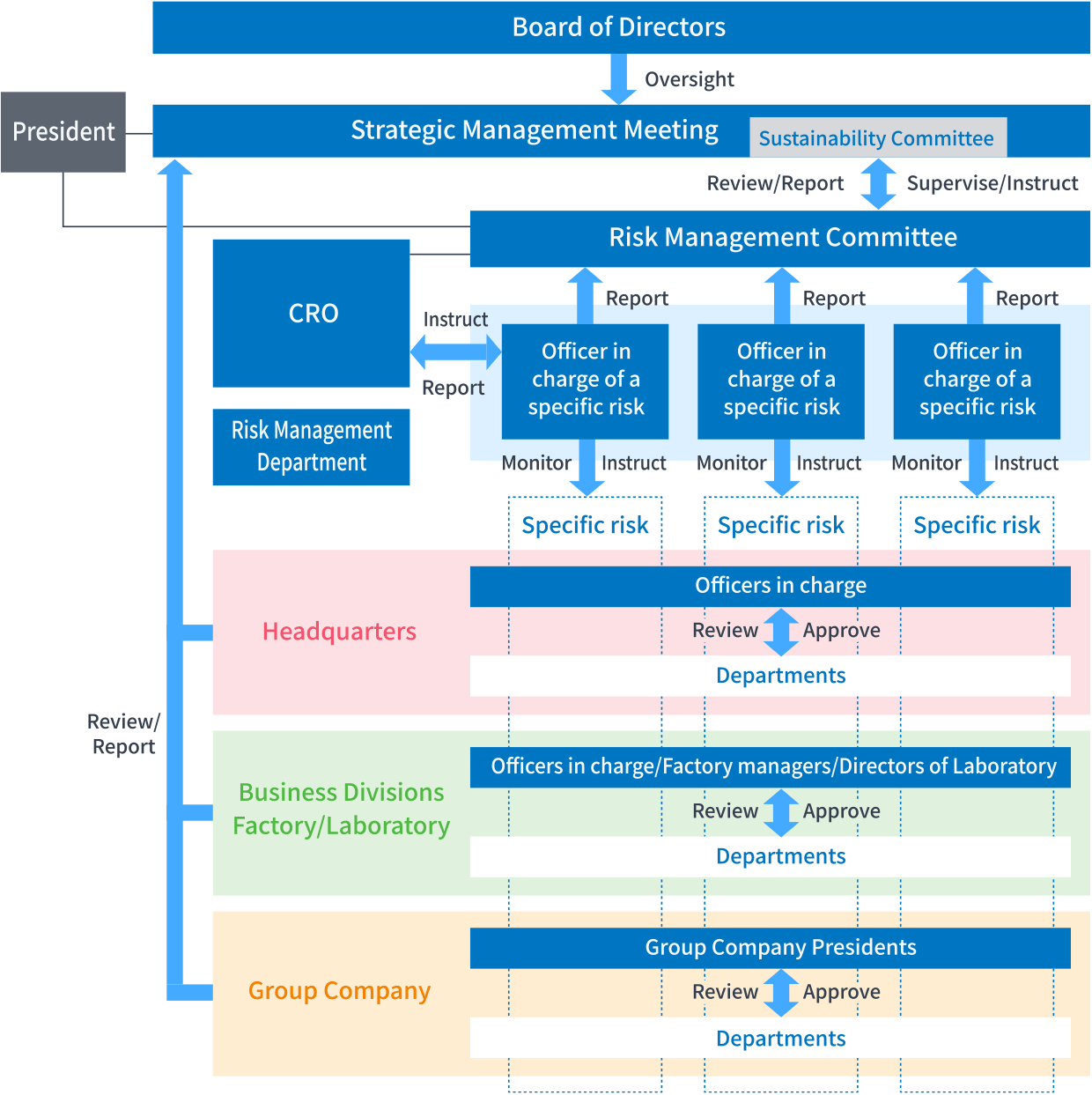
Based on the Basic Policy for Establishing Internal Control created via a resolution by the Board of Directors, the Company establishes risk management regulations and has created a risk management system encompassing every member of the Group. In this system, the President of UBE appoints a director or executive officer to serve as Chief Risk Officer (CRO). The CRO is responsible for promoting and supervising the implementation of risk management tasks for the UBE Group. The Sustainability Department Risk Management Group provides administrative and other support for the CRO, as the secretariat for risk management.

Management risks that impact the entire Group are deliberated upon by the Risk Management Committee. They are then submitted to the Strategic Management Meeting, where the members discuss their risk recognition and risk management approaches as well as the effectiveness of countermeasures. The details of reviews are regularly reported to the Board of Directors, which monitors risk management. Management risks are classified as strategic risks or as operational risks, whereupon individual officers in charge of specific risks are appointed to evaluate the risk concerned along with the effectiveness of relevant risk management measures from a Group-wide perspective. The officer then provides guidance and instruction to relevant departments for risk management measure implementation in the following fiscal year.

Through this Company-wide risk management, risks to the Group are mitigated, and should a risk materialize, damage will be minimized and its spread prevented. Corporate officers will also understand the risk and, through the construction and maintenance of a system able to make executive decisions that include proper guidance and the distribution of resources, will realize continued Group growth and the enhancement of corporate value.

In fiscal 2024, ongoing initiatives involving the enhancement of management via efforts involving audits of risk management, proper risk selection, and reviews of risk themes in accordance with changes in internal and external management conditions were conducted. In addition, executive staff established a two-tiered management system combining the UBE Risk Management System, which enables the top-down management of important risks that need to be managed by senior executives, with the Departmental Risk Management System, which enables autonomous bottom-up management by department heads. The quality of the Company-wide risk management was thus enhanced further.

Targets and Performance

Goals

Proper management of risks the UBE Group faces.

Commitment

As we aim to manage risks relating to both internal and external issues confronting the UBE Group in a systematic, comprehensive and autonomous manner, we develop and continuously improve our risk management system and structures.

Applying the UBE Group’s risk management to all consolidated subsidiaries and departments (fiscal 2030)

Performance

The Company’s risk management system has continuously been improved since its introduction in fiscal 2018, and in fiscal 2024, we launched ongoing initiatives involving the enhancement of management via audits of risk management, proper risk selection, and reviews of risk themes in accordance with changes in internal and external management conditions. In addition, executive staff established a two-tiered management system combining the UBE Risk Management System, which enables the top-down management of important risks that need to be managed by senior executives, with the Departmental Risk Management System, which enables autonomous bottom-up management by department heads. The quality of the Company-wide risk management was thus enhanced further.

Furthermore, we have introduced the Head Office Management System, which is based on those of the International Standards Organization (e.g. the ISO 9001 quality management system), at departments at UBE Head Office. By synchronizing management PDCA cycles among business departments, offices, and Group companies holding ISO certifications with regard to the handling of disclosure requests from stakeholders and responding to customer needs, we have strengthened mechanisms that enable our promotion of risk management as a global specialty chemical corporation.

UBE Group Risk Management System

Each department does a comprehensive review of risks through the PDCA cycle in the Departmental Risk Management System. They then select risks that impact the UBE Group from these and judge their levels based on their impact and frequency.

Management risks are linked to risk themes set by the Risk Management Committee (12 themes as of March 31, 2025) and universally addressed by all UBE Group companies. These risks are classified based on impact and frequency of occurrence into important risks, middle risks, and minor risks, with the following graph showing the registration status of each risk (766 as of March 31, 2025).

figure
Risk theme registration status (March 31, 2025)
Registered risks (March 31, 2025)
Registered risks at each department UBE Corporation Group companies* Total
Risk Theme 12 - 12
Management Risk 101 53 154
Important Risk 159 177 336
Middle Risk 105 75 180
Minor Risk 57 27 84
Total 434 332 766
  • *28 companies listed below

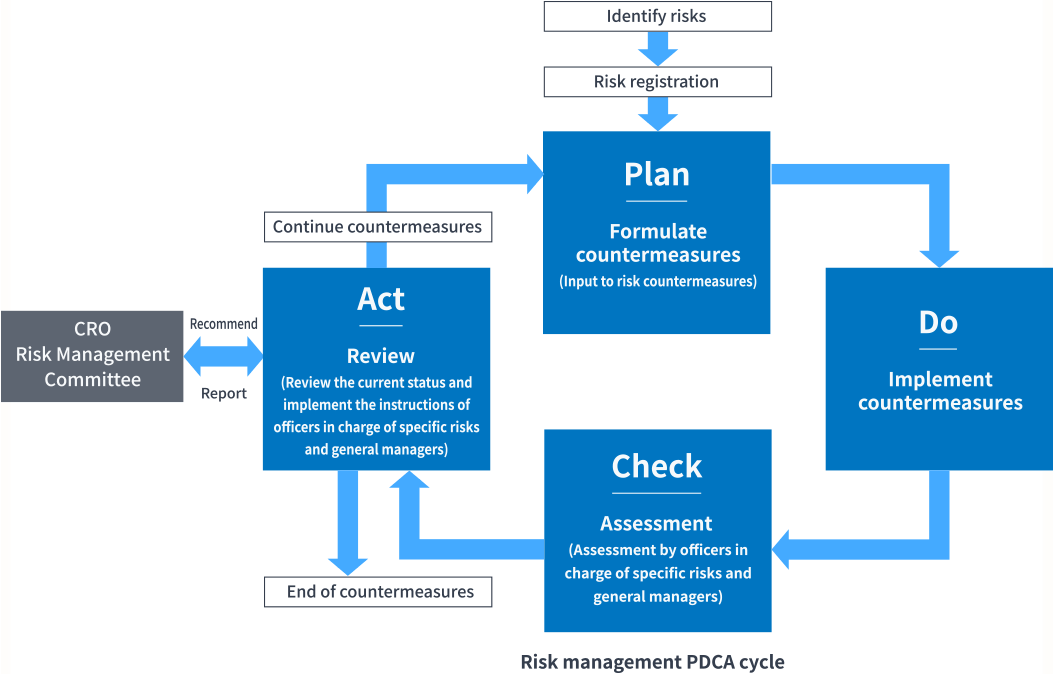
After being approved by department managers in accordance with their risk level, each risk is registered in the Risk Management System within the UBE Risk Management System, whereupon a PDCA cycle commences, beginning with hypothesizing risk scenarios and moving through creating countermeasures, enacting these measures, reviewing their effectiveness after implementation, holding discussions among managers in charge and the Risk Management Committee, and receiving instruction from top management. Top-down and bottom-up PDCA cycles act in a two-tiered management system where the entire UBE Group cooperates to create and promote Company-wide risk management that can comprehensively and appropriately manage risks that affect the UBE Group.

The following graph shows the utilization of risk management in the UBE Group, with 28 consolidated subsidiaries (90%) utilizing this system.

Domestic (11 companies) Overseas (17 companies)
UBE EXSYMO CO., LTD.
UBE MAXELL CO., LTD.
UBE Hydrogen Peroxide, LTD.
Ube Film, Ltd.
UBE Elastomer Co. Ltd.
Ube Logistics Service, Ltd.
UBE MACHINERY CORPORATION, Ltd.
T&U ELECTRONICS CO., LTD
Fukushima, Ltd.
Ube General Service Co., Ltd.
UBE Asset & Insurance, Ltd.
UBE Corporation Europe S.A.U
UBE Europe GmbH
Repol S.L.U (currently UBE Composites Europe, S.L.U)
Manufacturas Paulowsky S.L.U
UBE Chemicals (Asia) Public Co., Ltd
UBE Fine Chemicals (Asia) Co., Ltd.
UBE (Thailand) Co., Ltd.
Rayong Fertilizer Trading Co., Ltd.
Thai Synthetic Rubbers Co., Ltd.
UBE Engineered Composites, Inc.
UBE America Inc.
UBE CORPORATION AMERICA INC.
UBE Europe Belgium NV
UBE (Shanghai) Ltd.
Ube Machinery (Shanghai) Ltd.
UBE Machinery Inc.
UBE Machinery Thai Co., Ltd.

Initiatives

The main risk items considered to be relevant to the UBE Group’s business operations and have potential to materially affect investor judgment are as listed below.

  1. Variables that affect the operating results of each business
  2. Environmental issues
  3. Product quality and liability
  4. Major accidents (explosion, fire and leakage)
  5. R&D
  6. Natural disasters
  7. Information security
  8. Laws and regulations
  9. Human capital and human rights
  10. Financial market
  11. Overseas expansion (country risks)
  12. Intellectual property rights
  13. Acquisition and capital alliances
  14. Lawsuits
  15. Supply chain

Business and Other Risks

The UBE Group considers the following risk items to be relevant to its business operations and have the potential to materially affect investor judgment.

These risk items may negatively impact the Group’s operating results and financial position. As it is aware that these risks may materialize, the UBE Group has established the Risk Management Committee and is doing its utmost to avoid, disperse, or transfer such risks; develop countermeasures to be implemented when such risks materialize; and otherwise undertake robust crisis management measures.

Although the following includes items that will become relevant only in the future, the variables listed are determined based on decisions made by the UBE Group at the end of the fiscal year specified. Business and other risks recognized by the Group are not limited to those listed below.

(1) Variables that affect the operating results of each business

The UBE Group manufactures and markets a wide variety of products in the chemical and machinery fields and, accordingly, assumes the following risks.

①Chemicals business

In the area of structural reform projects, the UBE Group’s operating results may be negatively affected by a rapid increase in the supply of similar products manufactured by competitors should their production capacities be enhanced. These operations may be similarly affected if prices of benzene and other principal raw materials fluctuate radically due to changes in the balance of supply and demand worldwide or surges in the prices of such energy sources as crude oil, as these phenomena can cause the profit margin to narrow considerably. Moreover, because the Group depends on particular regions and suppliers to supply some raw materials, it may not be able to secure necessary materials should a supplier accident or other similar incident occur. As for specialty chemicals, the market entry of alternatives could cause a quick fall in sales of products the Group handles in such areas as IT devices and digitized home appliances. Accordingly, the Group’s operating results may be negatively affected by a decline in sales volumes due to a failure to meet customer requests in a timely manner or lower sales prices stemming from intensifying competition.

To address these risks, the Group is enhancing its profit base by proactively engaging in the following initiatives: (1) monitoring trends in the market prices of raw materials and swiftly translating raw material price hikes into product prices to secure appropriate spreads; (2) pursuing cost reduction measures at factories and downsizing the capacities of or withdrawing from low-profitability businesses; (3) accelerating growth in specialty chemicals through the prioritized allocation of management resources.

②Machinery business

The UBE Group’s mainstay products in the machinery business consist of die-casting machines, injection molding machines, conveyers, dust collectors, chemical processing equipment, crushing machines, and others. The Group’s operations in this area may be affected by a decline in the number of internal combustion engine vehicles sold or stagnation in public infrastructure projects. These operations may be similarly affected if surges in prices of raw materials and fuel cause the business performance of such corporations as power companies to remain stagnant for a long period of time or prompt businesses to embrace a more prudent stance toward capital expenditure aimed at promoting decarbonization or cut back on their budgets for repairs, resulting in a decline in orders received, products shipped, or services delivered by the Group. In the face of ongoing market globalization, the Group may also face a decline in sales due to the deceleration of economic growth at overseas market regions, fallout from trade friction, and a rise in competing manufacturers.

To address these risks, the Group is enhancing its profit base by proactively engaging in the following initiatives: (1) expanding and stabilizing profit through the enhancement of its post-sale service business, which encompasses products manufactured by other companies; (2) stepping up cost reduction measures; and (3) augmenting its capabilities to meet customer needs in such growth markets as those related to carbon neutrality solutions, DX, recycling, large-scale die-casting machines and injection molding machines that have come into demand alongside the transition to EVs, etc.

(2) Environmental issues

While aware of the need to tackle climate change, the UBE Group has effectively utilized coal in the course of pursuing business expansion. However, if carbon taxes are introduced or stricter regulations on carbon emissions are enforced, the Group may incur greater costs due to, for example, an increase in the tax burden. Furthermore, the UBE Group’s corporate value may be negatively affected by the stagnation of product sales due to poor ratings from stakeholders who consider the Group to be lagging behind others in climate change response within the context of growing public awareness of environmental conservation and the quickening pace of transition to a decarbonized society. If changes in the world’s natural environment lead to a higher frequency of natural disasters with greater severity, the Group’s production activities may be negatively affected due to damage to its manufacturing facilities, the disruption of its logistics network or difficulties in raw material procurement.

In addition, the Group’s corporate value may be negatively affected by the stagnation of product sales due to delays in its response to shifts in customer demand stemming from growing interest in circular economy, nature positive, and other such initiatives focused on preserving the global natural environment.

To address these risks, the Group has positioned tackling global environmental issues as its most important management challenge and has established the Environmental Issues Committee to evaluate and deliberate upon medium- to long-term strategies and policies for countermeasures. In addition, the Group is focused on curbing the emission of GHGs via promoting energy efficiency, revising processes, maximizing its use of renewable energy, reforming business structures, and developing revolutionary technology. Furthermore, the Group is also striving to develop and expand sales of environmentally friendly products, technology, and brands that utilize the Group’s strengths to contribute to the realization of a sustainable society. Products and development products that contribute to this realization include chemical products that utilize recycled materials (e.g. recycled composite resins) or biomass materials and chemical manufacturing that utilizes captured CO2 as a raw material (CO2 electrolysis).

(3) Product quality and liability

The UBE Group’s products are used in diverse areas, ranging from automotive parts, digitized home appliances and pharmaceuticals to living essentials and other commodities. These products are also used in social infrastructure development. Because of this, the release of a defective product to the market could have a widespread impact. Even if such a product was found to have caused no serious safety or human health issues, such an incident could cost the Group dearly both in terms of monetary expense due to product recalls or customer compensation and a loss of social trust, resulting in stagnation in its business activities.

To address these risks, the UBE Group is striving to establish a structure to prevent the unlikely production and release of defective products by, for example, properly maintaining equipment designed to enable stable process management, installing appropriate measurement instruments, preparing operational manuals, and educating employees. At the same time, the Group has obtained product liability insurance that covers incidents in Japan and abroad. Moreover, as part of countermeasures introduced against past improprieties, we have established the Group Quality Assurance Committee and hold an annual UBE Group Quality Conference. Thus, the Group is determined to ensure that lessons from the above incident are never forgotten, and is striving to prevent its recurrence through the enhancement of quality governance and the provision of ongoing education for all employees.

(4) Major accidents (explosion, fire and leakage)

The UBE Group’s manufacturing sites, particularly facilities used for chemical production, utilize a wide variety of hazardous substances as raw materials and are powered by a massive amount of high-pressure gas, electricity, steam and other energy sources. There thus exists the possibility of a major explosion, fire, or leakage due to a facility failure, human error, or natural disaster. If such an incident occurs, the life and well-being of the Group’s employees and residents of neighboring communities could be seriously threatened. Similarly, such an incident may result in significant damage to these people’s assets, in addition to affecting the surrounding natural environment to a great extent. This would, in turn, profoundly impact the UBE Group’s business performance by leading to a loss of opportunities due to the suspension of production activities or incurrence of expenses attributable to accident response, operational restoration, or the provision of compensation for customers or residents of local communities.

To address these risks, the Group has established the Group Environment and Safety Management Committee and has identified “Safety comes first” as a shared value in our environment and safety activities. This value is upheld in all aspects of our efforts to prevent explosion, fire, leakage, or other incident. These efforts include thoroughly practicing the basics of safety-oriented action; maintaining stringent compliance with relevant laws and regulations; undertaking periodic and appropriate inspections; maintaining and repairing facilities as necessary; securing well-educated and seasoned employees; preparing management manuals; implementing risk assessments via, for example, Hazard and Operability Study (HAZOP); transitioning to a smart factory through DX; executing periodic disaster drills; conducting environment and safety audits, and holding annual safety and health rallies.

(5) R&D

The UBE Group is engaged in R&D aimed at releasing new technologies and products in a timely manner to accommodate consumer needs while exploring the seeds of next-generation businesses. While the period required to complete an R&D project may be extended, the project itself may not progress as planned. If a new product development project sees significant delays in its schedule or is totally abandoned, the Group’s business competitiveness could deteriorate, exerting a negative impact on operating results. The Group’s pharmaceutical business could be similarly affected if governmental approval of a new pharmaceutical product is not granted as expected or withheld completely.

To address these risks, the Group assesses future market needs and allocates its management resources to priority businesses through efforts that include the establishment of new research sites to strengthen and expand its business portfolio. In this way, the Group is striving to accomplish its R&D goals earlier and enhance the accuracy of each R&D endeavor to secure further growth in specialty chemicals.

(6) Natural disasters

The UBE Group maintains manufacturing and sales bases in Japan and countries abroad. If these facilities were to suffer significant damage due to a major earthquake, typhoon, torrential rainstorm, tsunami, or other disaster on an unexpected scale, our production and/or sales activities undertaken at these sites could be suspended. This may, in turn, result in a loss of opportunity due to delays in raw material procurement or product shipments or cause the Group to incur considerable expenses in connection with the restoration of buildings and manufacturing equipment, the disposal of inventories, or the resumption of facilities. In short, any of these scenarios could negatively affect the Group’s operating results.

To address these risks, the UBE Group has set up the Crisis Response Committee and the Natural Disaster Countermeasure Committee in addition to preparing disaster response manuals and other documents, conducting systematic repair and reinforcement of manufacturing facilities, and executing periodic disaster drills and education. We also strive to identify and counter individual risks via the use of our risk management system. In order to ensure the early resumption of operations, we have also prepared business continuity plans (BCPs) in preparation for natural disasters. These BCPs are periodically rehearsed via drills and reviewed as necessary.

(7) Information security (Cybersecurity)

The UBE Group uses various systems for plant control and other operational purposes. If these systems were to be forced to suspend their operations due to cyberattacks, which become increasingly sophisticated every year, or other unforeseen incidents, the Group’s operating results could be negatively affected due to the stoppage of its production activities, payment of compensation for resulting damage or a loss of social standing. The Group could face similar consequences if an incident involving the leakage or destruction of important information occurs.

The UBE Group recognizes cybersecurity as an important management risk. We have thus set up an Information Security Committee, developed relevant regulations and ensured that our entire workforce is aware of them. Furthermore, we implement technical countermeasures aimed at detecting and preventing unauthorized access to our facilities. In addition, we prepare an IT-BCP and rehearse it through drills. We also provide all officers and employees with cybersecurity education and training while establishing a Computer Security Incident Response Team (CSIRT) and developing a structure to minimize damage arising from a security incident. The status of these and other countermeasures is periodically reviewed in order to make improvements and reduce cybersecurity risks. Furthermore, we strive to strengthen security measures through efforts that include working to understand the status of security measures taken by suppliers, partner businesses, and others as an initiative to enhance security across the entire supply chain. We also monitor how employees handle information to ensure that any unfair internal practices are quickly discovered and further offences prevented. Furthermore, an external Security Operation Center (SOC) run by specialists in the field operates 24 hours, 365 days per year to monitor incidents and maintain the emergency support system and enhance our systems in the event of an emergency.

(8) Laws and regulations

The UBE Group operates manufacturing and sales bases in Japan and abroad while supplying products to a diverse range of countries and regions. Accordingly, it needs to comply with laws and regulations associated with manufacturing and sales activities undertaken in each of these countries and regions. If any of these laws and regulations were to be revised, the Group may incur expenses when upgrading or altering manufacturing and other facilities or updating working environments. Furthermore, if the Group violates laws or regulations, it may be subjected to significant fines or penalties or be liable for damages. These violations could also result in the imprisonment of employees involved. If any of these risks were to materialize, the Group could face restrictions on its business activities or suffer from the deterioration of its social standing.

To address these risks, the UBE Group strives to ensure and practice legal compliance while endeavoring to prevent business conduct that could harm fair and open competition in the market. In order to secure the soundness of its corporate activities, the Group appoints Compliance Officers and has established the Compliance Committee, the membership of which includes corporate lawyers, to provide these officers with advice. Moreover, we have set up UBE C-Line, an internal reporting system, to accommodate direct reporting from officers and employees outside hierarchical reporting lines and ensure the swift detection and correction of compliance-related issues.

We have prepared a list of laws and regulations in Japan and countries overseas that are applicable to our business activities. We have also developed a structure for ensuring that departments in charge of operations governed by specific laws and regulations can share the latest information with other relevant departments regarding the revision or abolishment of such laws and regulations without omission. Furthermore, our risk management system is designed to identify legal and regulatory risks and inform the implementation of countermeasures against each such risk. We also strive to foster a corporate culture that honors and firmly maintains compliance with laws and regulations by, for example, conducting periodic e-Learning and training for all Group officers and employees.

In recent years, businesses have been facing a growing call for international trade management focused on ensuring security trade control. In response, we have established the Security Trade Control Committee as part of our structure for avoiding the risk of legal and regulatory violations in this area.

(9) Human capital and human rights

The UBE Group is operating amid intense market competition, and it is therefore essential to enhance the Group’s corporate value through the ongoing provision of products and services, the creation of innovative products and new markets, and the establishment of high-value-added business models. These endeavors require talent equipped with profound strength in their areas of expertise and capable of integrating diverse technologies, knowledge and perspectives to foster innovation. Moreover, it is similarly important to secure skilled workers and other similar talent equipped with know-how in such tasks as plant operations, as they play key roles in on-the-job training (OJT) and other educational and training activities. If the Group were to face difficulties in securing such talent or lose key talent, its operating activities could be negatively affected.

To address these risks, the UBE Group has identified a management policy of “advancing the initiatives of establishing a comfortable workplace and respecting individuality and diversity.” In line with this policy, we promote diversity, equity & inclusion. In addition to advancing women’s empowerment, we strive to help international and senior talent remain key workforce members while providing employment for and developing the skills held by persons with disabilities. We thus offer workplaces in which such members can find a sense of job fulfillment. Furthermore, we endeavor to regularly raise wages and otherwise improve the treatment of our employees. We also develop flexible workstyles that enable all our diverse talent to earn success while reducing working hours.

Meanwhile, the UBE Group and its supply chain are being called upon to step up efforts to address human rights-related issues in the midst of global public awareness of the relationship between business and human rights. If we were to fail to implement proper measures to this end, our corporate value could be negatively affected.

To address these risks, the UBE Group is striving to ensure respect for human rights throughout the supply chain and is, to this end, working together with its business partners in accordance with the UBE Group Human Rights Policy. We are also promoting the development of a human rights due diligence structure. Furthermore, we are developing an in-house structure for providing human rights-related education to ensure that all Group officers and employees maintain a correct understanding and awareness of such matters and remain capable of acting accordingly. In addition, with an eye to enhancing the Company’s medium- to long-term corporate value we have established the Group Health Promotion Committee. to conduct health-related investments in areas ranging from the management of illness to the promotion of health improvement measures. Moreover, we have established the Human Resources and Human Rights Committee, which promotes HR strategies linked to the Group’s management strategies, strives to ensure respect for human rights, and identifies risks related to these matters, thus creating a system for setting policies and targets.

(10) Financial market

The UBE Group procures funds through borrowings from financial institutions, the issuance of corporate bonds and other methods. If drastic turmoil in a key financial market makes it impossible for the Group to procure funds under favorable terms and conditions, the Group may fail to secure sufficient funds for growth investment and other endeavors. Similarly, a major downgrading of the Group’s credit ratings or other incident leading to the drastic deterioration of its creditworthiness could hinder fundraising efforts.

To address these risks, the Group is focused on maintaining robust cash flows in the course of business management while securing and maintaining a sound financial position. We also strive to secure sufficient liquidity by retaining cash, deposits, commitment lines, and other methods in addition to dispersing repayment (redemption) periods and diversifying fundraising methods. By doing so, we strive to mitigate the impact of fluctuations in the fundraising environment. Furthermore, although the UBE Group is exposed to foreign exchange fluctuation risks due to its involvement in importing raw materials and exporting products, the Group endeavors to balance the overall volume of monetary claims and obligations while, as necessary, executing foreign exchange forward contracts in order to mitigate the impact of such risks.

(11) Overseas expansion (country risks)

The UBE Group’s chemicals and machinery businesses run a number of production, development, and service bases in countries abroad, mainly in Asia, North, Central and South America, and Europe. In fiscal 2024, the Group’s overseas sales accounted for around 54% of its consolidated net sales. These business activities inherently involve exposure to risks arising from deteriorating political or economic situations in countries overseas; social turmoil due to war, conflict, terrorism or other similar incidents; the enforcement of harsher regulations on foreign businesses in the destination country; changes in economic or trade policies; stronger environment-related regulations; and labor disputes. If any such risk materializes, the Group’s operating results could be negatively affected.

To address these risks, the UBE Group has prepared manuals describing how to consolidate information and otherwise respond to emergencies in order to ensure that an incident affecting its overseas businesses is swiftly handled. We also effectively utilize consultants specializing in this field. Furthermore, we have secured a structure in which the Crisis Response Committee plays a central role in gathering necessary information and sharing it with locations in affected regions in a timely and appropriate manner. In addition, we made it a rule to establish a crisis response headquarters during emergencies to implement swift and accurate countermeasures even as we place the utmost priority on the safety of our employees.

(12) Intellectual property rights

The UBE Group considers intellectual property rights important assets and, accordingly, strives to enhance its business competitiveness via the use of such assets. However, there is a possibility of unforeseen incidents leading to an outflow of the Group’s important technology and know-how or the infringement of its intellectual property rights. On the other hand, if the Group were to be involved into a legal dispute with another company over intellectual property rights, the Group may be subjected to an unfavorable court ruling. This could, in turn, cause the Group’s business competitiveness to decline and negatively affect its operating results.

To address these risks, the Group is striving to acquire and manage intellectual property rights at home and abroad and to properly manage data regarding its technological know-how and other informational assets. By doing so, we endeavor to protect our intellectual property rights. Moreover, we honor intellectual property rights possessed by third parties and make every effort to ensure patent clearance.

(13) Acquisition and capital alliances

The UBE Group is engaged in corporate acquisition, capital alliances, and other measures aimed at expanding its operations, acquiring technologies and enhancing its competitiveness at home and abroad. These endeavors, however, could negatively impact the Group’s operating results if it fails to achieve synergetic effects as initially expected or due to failed efforts to improve costs, the discovery of unforeseen defects, an unexpected expansion of liability, or the deterioration of corporate value due to stagnant business performance or a worsened financial position of investees.

The Group is doing its utmost to reduce these risks by, for example, conducting appropriate market surveys and due diligence at a stage before acquisitions and capital alliances take place, taking a prudent stance in business assessments and contract negotiations while implementing processes to ensure sufficient internal discussions. We also invest sufficient management resources to realize smooth integration and partnerships with the Group following acquisitions and when entering capital alliances and strive to monitor these efforts appropriately.

(14) Lawsuits

The UBE Group may be involved into lawsuits or other legal proceedings in the course of handling the wide range of businesses in Japan and abroad. Although it is inherently hard to predict the future impact of such incidents, it is safe to say that the Group’s operating results may be negatively affected if it is subjected to an unfavorable ruling or judgment in a lawsuit or other proceeding. The main cases currently undergoing legal proceedings are as described below.

Since May 2008, a series of lawsuits have been filed by construction workers and their bereaved families against the Japanese Government and over 40 construction material manufacturers, including UBE Board Co., Ltd. (a consolidated subsidiary), in connection with asbestos-related diseases allegedly induced by the inhalation of dust from asbestos-containing materials used at construction sites. Although these plaintiffs have filed class action lawsuits requesting compensation for damages, all court rulings issued thus far have rejected claims against our subsidiary. Today, however, 15 of such cases are still pending at several courts across Japan, with a total of ¥7.1 billion in compensation demanded for damages.

Informed by an awareness of the implications of these suits and other litigation risks, we regularly implement training on legal and regulatory compliance while gathering information related to laws and regulations applicable to our operations to prevent the occurrence of such disputes. Even in cases where the Group is involved in lawsuits, we handle such lawsuits by collaborating properly with lawyers and other specialists. By doing so, we endeavor to mitigate impacts on our business performance.

  • Note:The above-mentioned amount of compensation represents the sum of all claims collectively filed against defendants, including UBE Board and other construction material manufacturers.

(15) Supply chain

The UBE Group procures a variety of raw materials, fuels, and other resources from suppliers at home and abroad while also shipping its products to domestic and overseas customers. In the course of procurement, the Group may be affected by surges in raw material and fuel prices or the disruption of procurement routes due to the bankruptcy of affiliated companies, the breakout of war, conflict, terrorism, or pandemics, the occurrence of natural disasters, deterioration of global environmental issues, or the discovery of human rights violations. In the area of logistics, the Group may incur higher costs or face disruptions to its network due to driver shortages, the tighter regulations around drivers working overtime, or higher fuel costs.

To address these risks, the Group has established the Supply Chain Management Committee to manage the risks the UBE Group is facing that are related to sustainable procurement across the entire supply chain as well as to promote initiatives related to sustainable procurement that include the establishment of basic policies on procurement and guidelines. Where appropriate, the Group also engages in negotiations and builds partnerships with suppliers and strives to address hikes in raw material, fuel, and resource prices in a way that complies with relevant laws and regulations, such as the Act against Delay in Payment of Subcontract Proceeds, Etc. to Subcontractors. Also, the Group strives to mitigate the impact of such price hikes on profit by swiftly aligning product prices with them while cutting back on manufacturing costs. To address the risk of disruption in procurement paths, we disperse the locations of raw material and fuel suppliers as well as our production bases while building our stockpiles to essential volumes. In this way, we strive to minimize the impact of risks on the Company’s business activities by immediately deploying prepared countermeasures. We are also engaged in appropriate negotiations that comply with relevant regulations as we further pursue a modal shift in our domestic logistics activities to counter rising logistics costs and risks of disruption. Toward this end, we are constantly striving to secure a stable international transportation structure by employing multiple transportation methods. To reduce the burden on drivers in Japan, we have expanded the lot size of cargos to be transported and reduced the volume of small-lot cargos handled even as we consolidate the number of vehicles in our operations. In addition, we act in collaboration with our partner companies tasked with on-premises logistics to assess and reduce drivers’ waiting time as well as time spent loading and unloading as we strive to build a logistics network founded on good practices.